Hello everyone!
After reviewing the Wave 1 units, and then introducing those from Wave 2, we now want to take a closer look at the various faction cards associated with these two waves, as announced in our previous articles.
We will follow the same approach for each race in StarCraft: Tabletop Miniatures Game. For future waves, we will combine the unit introductions and card analysis directly into dedicated articles.
We won’t be covering the scenario cards in detail. Instead, we’ll focus on faction cards and tactical cards, exploring the options they provide and the role they play in the game.
Faction Cards:
Khalai:
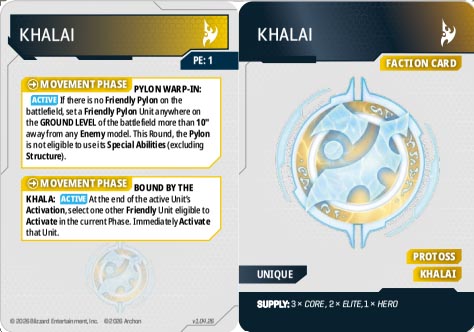
Representing the Protoss who follow the Khala, this faction card offers 3 Core slots, 2 Elite slots, and 1 Hero slot. It allows you to deploy a Pylon for free and chain activations during the Movement Phase, helping you retain the First Player token—which is already pretty easy to do when playing Protoss!
The Pylon Warp In ability allows you to bring a Pylon onto the battlefield, providing several benefits starting the round after it is deployed. It serves as a deployment point for one unit per round and reduces the cost of a Special Ability used within 4″ by 1 PE, once per round. It also forces your opponent to commit resources to destroying it.
Unlike Daelaam, which focuses more on repositioning your troops, Khalai encourages you to concentrate your forces around the Pylon to make the most of its bonuses.
Daelaam:
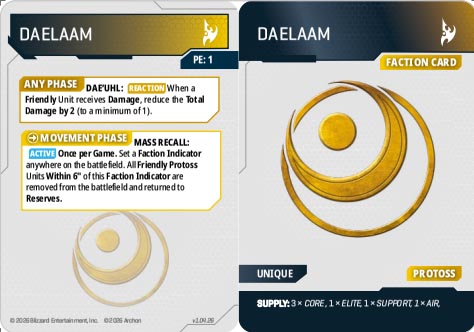
This subfaction, representing the unification of the Protoss, offers 3 Core slots, 1 Elite slot, 1 Support slot, and 1 Air slot, which will probably become useful as future waves are released.
Dae’uhl reduces incoming damage, making your units more resilient at a critical moment.
Mass Recall activates during the Movement Phase and allows you to remove all units within 6″ of a Faction Indicator from the battlefield and place them in Reserves, even if they are engaged. This ability is particularly useful for extracting your troops from a dangerous situation and redeploying them more advantageously later on.
It’s difficult to compete with the options offered by Khalai! Nevertheless, this card remains an interesting choice for players looking for a new challenge or wanting to focus on mobility, offering a different way to play their army.
Nerazim:
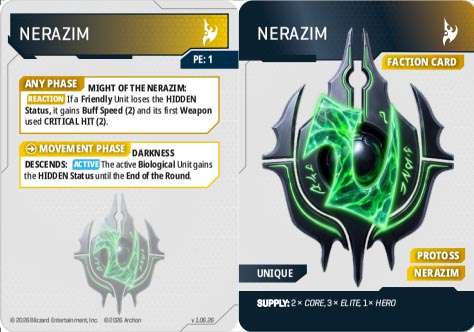
The Nerazim faction card provides interesting support for Zeratul’s forces, with gameplay focused on the Hidden status and surprise attacks. It allows you to build your list with 1 PE slot, 2 Core slots, 3 Elite slots, and 1 Hero slot.
Darkness Descends allows you to grant a friendly Biological unit the Hidden status during the Movement Phase, lasting until the end of the round. This is particularly useful for protecting Zealots and Adepts, which do not naturally have access to this ability, while supporting lists built around stealth, especially those featuring Nerazim Watchers.
Might of the Nerazim, meanwhile, triggers when a friendly unit loses the Hidden status. The unit gains +2 Speed, and its first attack gains Critical Hit (2), encouraging an aggressive and powerful strike from stealth.
Overall, this card allows you to protect your Biological units before engaging the enemy, then boost their offensive potential at the right moment. It offers a different tactical approach to traditional Protoss gameplay, and one well worth exploring!
Tactical Cards:
Forge:
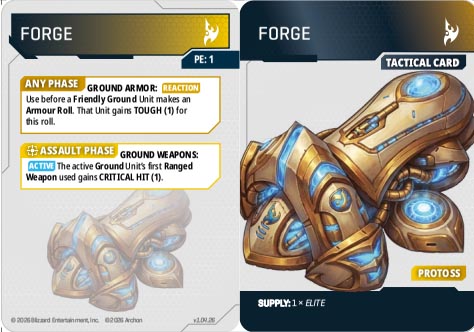
The Forge card offers one Elite slot and lets you choose between two effects.
Ground Armor allows a Ground unit to gain Tough (1) during an Armor roll. This helps limit incoming damage, particularly against attacks that inflict multiple wounds. Its main advantage is that it can be used during any phase, giving you flexibility to protect a unit at the right moment.
Ground Weapons grants Critical Hit (1) to a Ground unit’s ranged weapons during the Assault Phase. This bonus increases the unit’s lethality, particularly when combined with Surge, or simply by helping bypass Heroes’ Armor saves.
Gate Chronoboosted (Unique):
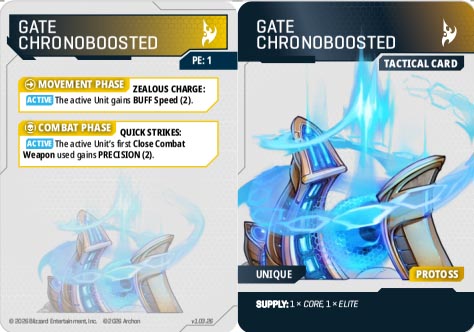
This card offers one Elite slot and one Core slot.
Zealous Charge grants a +2 Movement bonus during the Movement Phase. This is useful for quickly advancing melee-focused units and getting them into contact with the enemy.
Quick Strike grants Precision (2) during the Melee Combat Phase, improving the reliability of attacks and their ability to deal damage.
Gateway:
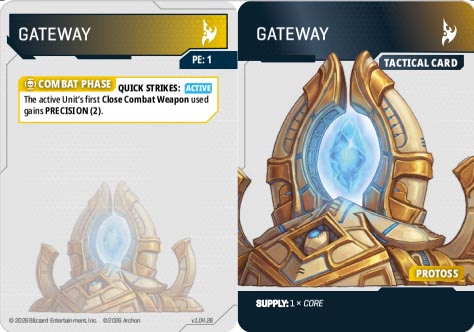
This card provides one Core slot. It also offers Quick Strike, which grants Precision (2) during the Melee Combat Phase, increasing the lethality of the affected units.
Its other advantage is that it allows you to recruit Zealot units, which require two Core slots. Finally, it is a cheaper option than Gate Chronoboosted when building your army list.
Nexus (Unique):
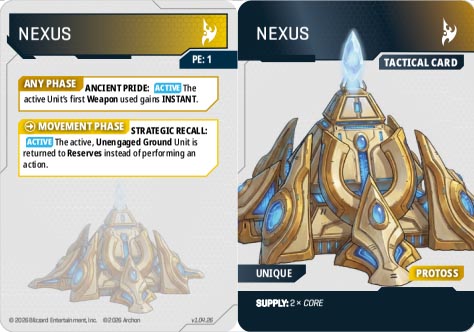
This card offers two Core slots and lets you choose between two effects.
Ancient Pride grants Instant, an ability that can be used during any phase. It can help bypass enemy reactions at a crucial moment and maintain the initiative in a decisive situation.
Strategic Recall allows you to return an unengaged Ground unit to Reserves during the Movement Phase. This can help correct a deployment mistake or adapt to changes in positioning as the game progresses. However, returning to Reserves comes with significant restrictions: the unit cannot be redeployed immediately, and the action consumes its activation. This limits its tactical applications.
Observer (Unique):
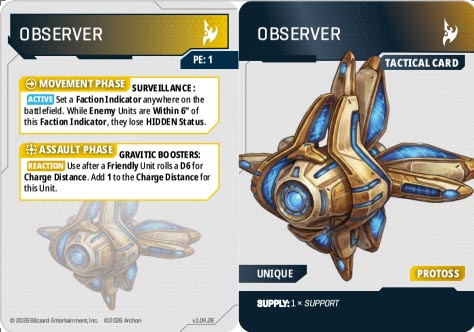
This card offers one Support slot and provides two effects that can be used during the Movement Phase.
Surveillance allows you to remove the Hidden status from enemy units within 6″ of a marker placed on the battlefield. This is particularly useful against Zerg armies, which can burrow their units to conceal them and prepare their attacks.
It is the only way to remove the Hidden status from enemy units apart from the ability associated with the Nerazim Watchers token, which is exclusive to the Nerazim subfaction. In this context, including an Observer in your list becomes almost essential if you want to avoid being left without an answer against armies that rely on stealth.
Gravitic Boosters allows you to add +1 to a Charge roll. Its main advantage is that it can be used after the roll has been made. You can therefore wait to see the result before activating the ability, helping secure a Charge that would otherwise have failed by a narrow margin.
Overcharged Nexus (Unique):
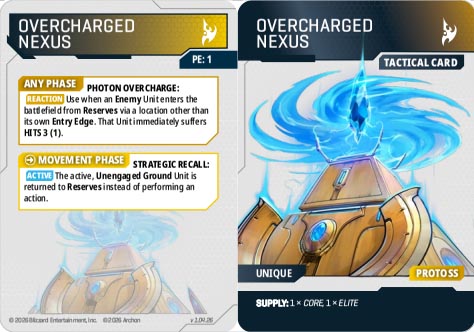
This card offers one Elite slot and one Core slot. Like the Nexus, it provides Strategic Recall, which allows you to remove an active, unengaged Ground unit from the battlefield and place it in Reserves, with the same restrictions.
In exchange for losing the Instant effect, Photon Overcharged immediately inflicts three hits, each dealing 1 damage, on a unit that has just arrived from Reserves. Its use is fairly situational, but it can prove particularly troublesome for Raynor’s Raiders, for example, if their strategy relies on deploying units from Reserves.
Power Field (Unique):
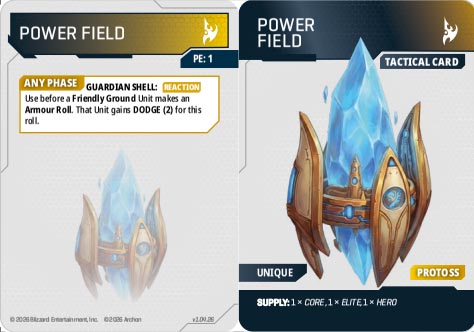
This card offers one Hero slot, one Elite slot and one Core slot. It is notably what allows you to include Artanis in an army outside the Khalai subfaction, or add a second Hero to certain army compositions.
Its main advantage is Guardian Shell, which grants Dodge (2). This protection helps mitigate additional damage caused by Surge or Critical Hit. Aside from Evade and reactive healing, Dodge is one of the few ways to counter these effects.
Robotics Facility:
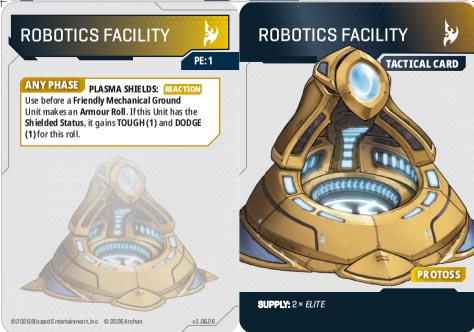
This card unlocks two Elite slots and provides Plasma Shields, a reaction that allows a Shielded Mechanical Ground unit to gain Tough (1) and Dodge (1) for that Armor roll.
This is a useful effect to keep in reserve to protect a unit at a critical moment. The two Elite slots also allow you to include an Immortal and a pair of Stalkers to make the most of this card.
Twilight Council (Unique):
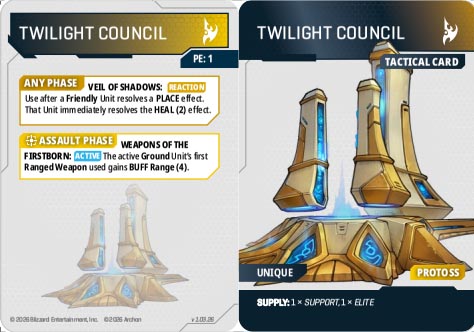
This card offers one Elite slot and one Support slot. It combines two interesting effects.
Veil of Shadows allows you to gain Heal (2) after resolving a Place effect. At present, this is the only identified way to regenerate, making it particularly useful for keeping units in fighting shape.
Weapons of the Firstborn increases the range of a unit’s first ranged attack by 4″. This bonus can help you hit a target without unnecessarily exposing your troops, or take advantage of a shooting opportunity that would otherwise be out of range.
Void Seeker (Unique):
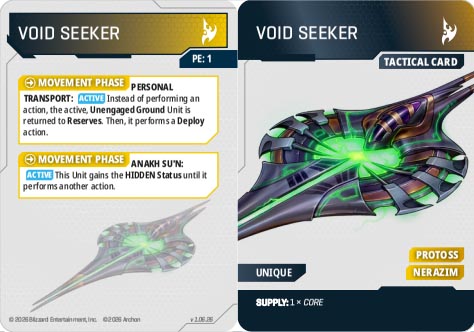
Restricted to the Nerazim subfaction, this card offers only one Core slot. However, it provides two particularly interesting tactical options.
Anakh Su’n allows you to give a unit the Hidden status, while Personal Transport lets you return an unengaged unit to Reserves and then immediately redeploy it.
The Hidden status is already useful, but it is the second ability that makes this card exceptional. It allows you to reposition a unit during the game and open up new tactical opportunities without waiting for a later round. For a Nerazim army, this card deserves a place in the list.
Warp Gate (Unique):
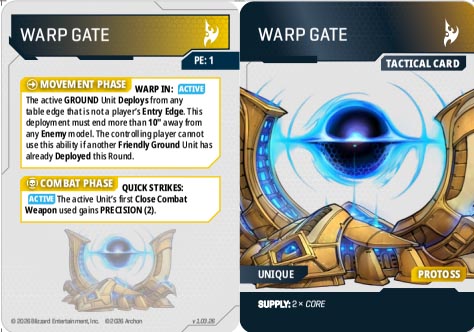
This card offers two Core slots and provides two options.
Quick Strikes grants Precision (2) in melee, improving the reliability and damage potential of attacks.
Warp In allows the first unit deployed during the round to arrive from any table edge that is not controlled by a player, more than 10″ away from any enemy unit.
The main limitation is the first-deployment requirement, which restricts its use despite the Protoss already having several mobility options. However, this ability can be particularly useful in rounds 2 or 3, for example after recalling units already on the battlefield to Reserves.
It is important to note that the restriction applies to the first unit deployed, not the first unit activated during the round. You can therefore wait to see how your opponent positions their forces before bringing in Adepts, Stalkers or Zealots to threaten a key target directly. This is an interesting tactical option for catching your opponent off guard and exploiting gaps in their formation.
Warp Prism (Unique):
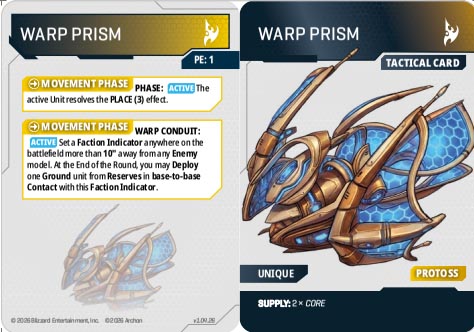
This card offers two Core slots and provides two options.
Phase allows you to use a Place (3) effect during the Movement Phase, providing a way to reposition quickly across the battlefield.
Warp Conduit allows you to place a token anywhere on the board, more than 10″ away from any enemy model. After scoring, the Leader model’s base of a unit is placed in base-to-base contact with the token, and the rest of the unit is deployed normally.
The manoeuvre is relatively predictable for your opponent, but it offers clear tactical advantages. It can either allow a unit to advance rapidly across the battlefield or force your opponent to react by blocking the token’s placement. Even when it does not directly catch the enemy off guard, this threat can influence their positioning and limit their options.
This brings our review of the cards from the first two Protoss waves to a close. Once the articles are finalised, we will of course be bringing you similar articles covering the Terran and Zerg factions. We will then begin a series of faction reviews, with a dedicated article covering the units and cards introduced in each upcoming wave.
As always, we’d love to hear your thoughts. Feel free to share your own experiences and opinions in the comments, we’re looking forward to discussing the game with the community!
Don’t missed to support us on PATREON!
Questions, ideas, spelling error or just want to share your thoughts? Leave a comment below! And if you enjoy our work, a little support would help us keep creating more and more content.
See you soon!