Hello everyone,
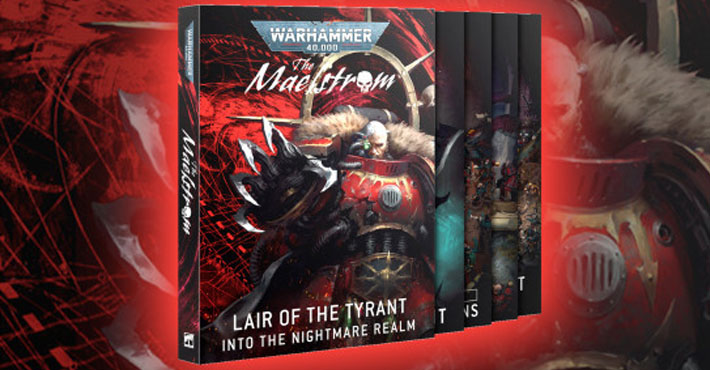
After bringing you a review of 500 Worlds: Titus, we are now turning our attention to the second installment of this end of 10th edition campaign series: The Maelstrom – Lair of the Tyrant. Once again, we will leave the in-depth rules analysis to the specialists and focus instead on what interests us most: the evolution of the lore and what it brings to the setting.
From the moment it was announced, this volume seemed far more promising than its predecessor. The reason is simple: it features the return of Huron, an iconic and essential figure ever since the Badab War. That alone is enough to raise expectations, as the character is both rich and steeped in history, straddling the line between a formidable strategist and a fallen tyrant turned lord of the Maelstrom.
As such, we hope this new book will deliver a denser and, above all, more ambitious narrative than 500 Worlds: Titus. That previous installment left us with mixed feelings, as its conflict ultimately felt underdeveloped, lacking scale and amounting almost to a single battle with little real progression or significant consequences.
With Lair of the Tyrant, the stakes appear different: to delve deeper into a chaotic war zone, explore Huron’s ambitions, and provide a storyline capable of genuinely advancing a broader narrative. It remains to be seen whether that promise will be fulfilled.
The Maelstrom is a region of space where the boundary between realspace and the Warp has been torn apart, creating a permanent anomaly with ever-shifting and unstable borders. This constantly fluctuating environment makes navigation extremely dangerous: establishing reliable long-term charts is impossible, while the Astronomican struggles to penetrate the region sufficiently to guide Imperial fleets effectively. As a result, the Maelstrom has become an ideal refuge for pirates, renegades, and the forces of Chaos. Space battles are frequent, as the Imperium is unable to impose lasting authority over the area. Any fleet venturing into the Maelstrom risks becoming lost, scattered, or emerging in entirely unexpected regions of space.
One question nevertheless remains: how do certain factions, most notably the Red Corsairs, manage not only to survive but also to prosper and build genuine empires in such a hostile environment, while most other powers struggle to operate there for extended periods? As is often the case in the Warhammer 40,000 universe, some aspects are driven more by narrative necessity than by absolute consistency. Despite these lingering questions, the Maelstrom remains one of the most fascinating locations in the lore. For many years, it served as an iconic theatre of war with a distinct identity of its own. Like other famous regions such as the Eye of Terror, it was the setting for numerous campaigns and stories, providing players with a rich backdrop for intrigue and narrative opportunities. However, since the emergence of the Great Rift, the Maelstrom has somewhat lost its exceptional character. Once one of the largest Warp rifts in the galaxy, it is now merely one anomaly among many in a galaxy torn apart from end to end. For many long-time players, this evolution has diminished the uniqueness of a once-mythical location, reducing some of the aura and mystery that once surrounded it.
The regions surrounding the Maelstrom nevertheless remain of immense strategic importance. Despite the area’s instability, they are rich in rare resources, isolated worlds, and ancient relics sought after by the Imperium, xenos races, renegades, and the forces of Chaos alike. The few relatively stable routes that allow these riches to be exploited and transported are vital corridors. Unsurprisingly, they have become prime targets for pirates and corsairs. To secure these commercial and strategic routes, the Imperium must commit substantial military resources. Even so, control of the region remains tenuous at best.
The book provides a detailed description of New Badab, Huron Blackheart’s new stronghold and primary base of operations since the end of the Badab War. Architecturally, the city retains many features inherited from the Imperium, but these have been twisted and reshaped to glorify its master. Monumental statues, colossal fortifications, and symbols of domination constantly reinforce Huron’s absolute authority over his domain. Within New Badab, Red Corsairs, humans, xenos, mercenaries, mutants, and slaves coexist, more or less, under the ruthless rule of the Tyrant of the Maelstrom. This unusual diversity reflects Huron’s pragmatism, as he is far more concerned with usefulness and loyalty than with the ideological dogmas that govern most other galactic powers.
However, Huron’s influence extends far beyond New Badab. Over the centuries, he has built a true pirate empire known as the Tyrant’s Crown. This confederation of worlds, space stations, and strongholds scattered throughout the Maelstrom now represents one of the most significant independent powers in the region. Numerous planetary systems pay tribute to him or acknowledge his authority, either directly or indirectly.
The book also highlights the presence of other renegade forces operating within this empire. Warbands drawn from the Word Bearers and the Iron Warriors are regularly active there, attracted by the opportunities offered by a region beyond Imperial control. The famous Blackstone Fortress gifted to Huron by Abaddon the Despoiler is also located within his domain. This relic of immeasurable power remains the focus of constant activity, as its servants tirelessly seek to understand its mechanisms and unlock its full destructive potential.
One of the book’s greatest strengths lies in its detailed descriptions of the many worlds, bases, and spheres of influence that make up the Tyrant’s Crown. These additions provide welcome depth to a region that is often mentioned but rarely explored in such detail. They also serve as an excellent source of inspiration for players interested in narrative campaigns, offering a setting rich with intrigue, conflict, and opportunities for storytelling at the heart of the Maelstrom.
The book then presents a chronological timeline of the Maelstrom. However, it adopts an approach that may feel unusual to readers familiar with the older timelines of the Warhammer 40,000 universe, before the arrival of the Great Rift and the narrative upheavals that accompanied the restructuring of the setting’s chronology.
This periodisation is particularly interesting, as it helps illustrate the evolution of the Maelstrom across the millennia and places the many events that shaped the region into a broader perspective. Nevertheless, it is somewhat disappointing that the Badab War receives only limited attention. Given its historical significance for Huron and the excellent treatment it received in the Imperial Armour volumes dedicated to the conflict, one might have expected a more comprehensive examination.
One of the timeline’s main weaknesses lies in its dating system. The chronological markers employed often remain abstract and fail to provide clear points of reference for the reader. Whereas older timelines made it relatively easy to place major events within the broader history of the galaxy, this new presentation sometimes creates the impression of moving through a succession of eras whose temporal relationships remain vague. Despite this criticism, the section remains enjoyable to read. The various entries are detailed enough to bring the region to life and highlight both events long familiar to veteran enthusiasts and entirely new additions to the lore.
The Maelstrom is, above all, a haven for all those seeking to escape the light of the Emperor and the control of the Imperium. However, it is important not to equate the inhabitants of this region with the servants of Chaos. While the forces of Chaos are naturally widespread there, a large proportion of the individuals and factions that take refuge within the Maelstrom are not necessarily affiliated with them. Renegades, pirates, independent empires, mercenaries, and even entire populations that have rejected Imperial authority without worshipping the Dark Gods can all be found within its borders.
The book notably highlights the regular presence of the Leagues of Votann in the region. Drawn by the rare resources and economic opportunities offered by the worlds surrounding the Maelstrom, they do not hesitate to venture into these dangerous territories in search of deposits that cannot be found elsewhere in the galaxy. Their presence serves as a reminder that the Maelstrom is not merely a battlefield or a pirate haven, but also a region coveted for its wealth.
One of the most interesting aspects of the book concerns the way Huron maintains and expands the power of the Red Corsairs. Unlike many Chaos forces that benefit from devoted worlds or the direct support of the Ruinous Powers, the Red Corsairs rely heavily on predation and plunder. Raiding is therefore both a strategic necessity and a way of life. It allows them to acquire resources, weapons, slaves, industrial equipment, and, most importantly, new ships.
In the Maelstrom, nothing goes to waste. Every prize has potential value. A simple merchant freighter can be converted into an auxiliary vessel, a logistics ship, or even a future warship after extensive modifications. This culture of constant salvage and repurposing gives the Red Corsairs a distinctive identity, somewhere between a pirate fleet and a genuine expanding empire.
The book also describes the hierarchical structure of the Red Corsairs and the mechanisms that allow Huron to maintain his authority over such a disparate organisation. Alliances of convenience, rewards, intimidation, and promises of wealth all play a crucial role in holding this heterogeneous coalition together.
Finally, one of the book’s most original elements concerns the recruitment of new Space Marines. Whereas many stories portray the Adeptus Astartes as virtually incorruptible and unwaveringly loyal to the Emperor, the book adopts a more nuanced perspective. It demonstrates how some Space Marines can gradually become renegades through isolation, resentment toward the Imperium, the pressures of war, or simply a desire for survival and freedom. This more pragmatic depiction of the path to rebellion adds welcome depth and helps explain how the Red Corsairs continue to replenish their ranks despite the constant losses they suffer.
Ultimately, this section of the book succeeds in portraying the Maelstrom as a genuine political, economic, and military ecosystem. Far from being merely a Warp anomaly populated by Chaos fanatics, it emerges as a complex region where competing interests, personal ambitions, and perpetual power struggles intersect.
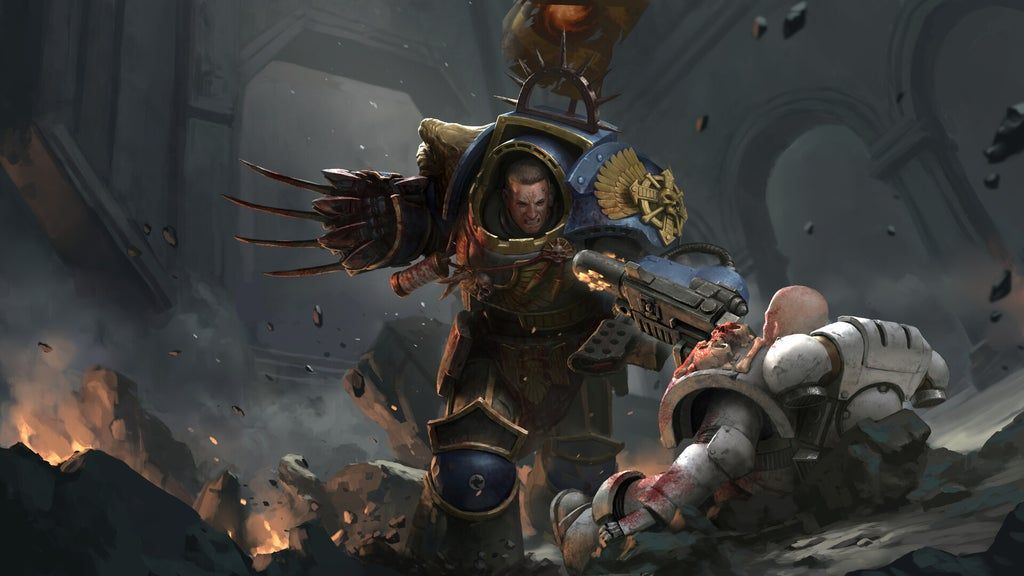
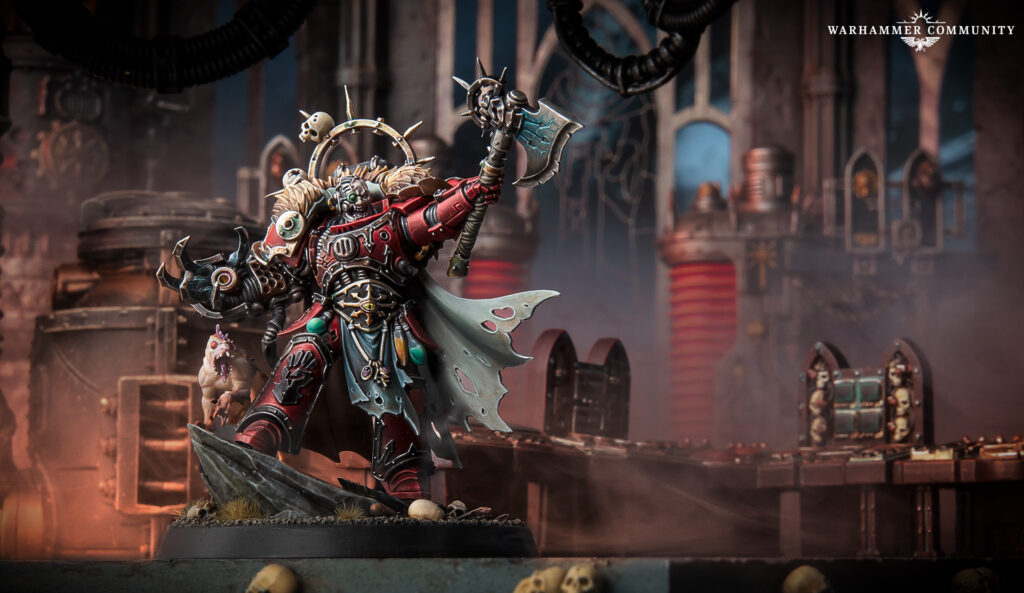
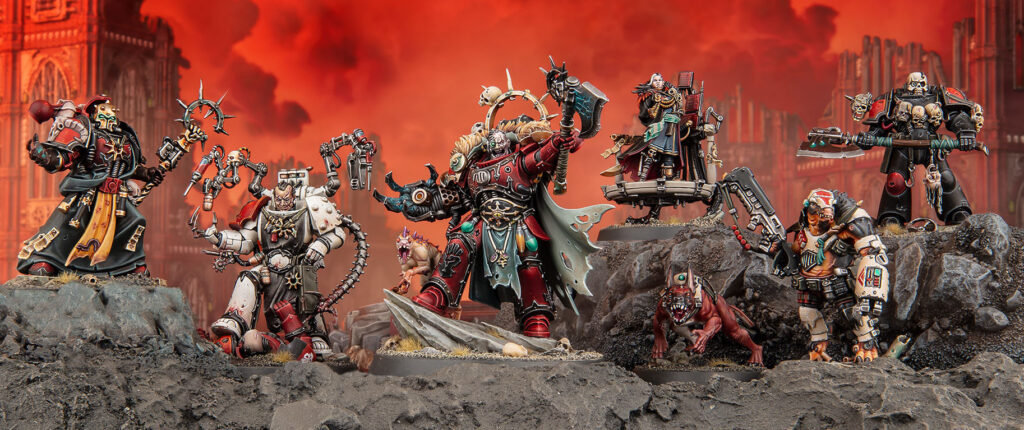
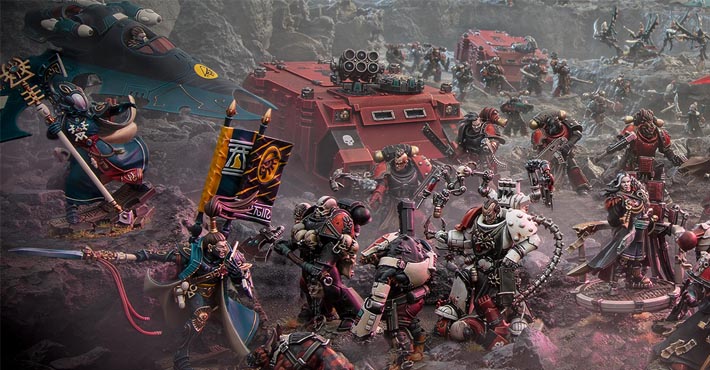
The book then moves on to a description of Huron and his principal lieutenants, many of whom can also be found in a superb command box whose miniatures live up to Games Workshop’s current standards.
Lufgt Huron’s past is briefly revisited. His charisma and ambition enabled him to rally several Space Marine Chapters to his cause despite their continued loyalty to the Imperium. When Imperial authorities uncovered this deviation from the Imperial Creed, the Badab War erupted. Following the defeat of the Astral Claws, Garreon survived alongside Huron’s remaining loyal followers. Together with his apprentice Variel and the Master of the Forge Armanneus Valthex, he helped reconstruct the grievously mutilated body of their lord, whom the Imperium believed to be dead. Over the following decades, through a succession of conquests and the integration of countless survivors and renegades into his ranks, Huron subjugated system after system until he became the undisputed master of the Maelstrom. He ruthlessly eliminated anyone he perceived as a potential threat to his authority, gradually forging a true pirate empire at the heart of this chaotic region of the galaxy.
Huron is accompanied by the Hamadrya, a mysterious creature whose origins remain unknown. It appears to grant him a degree of foresight and prophetic insight. The relationship between the two is particularly intriguing: the Hamadrya exists in symbiosis with Huron to such an extent that one cannot help but wonder whether Huron is truly the master in this partnership or whether he is, in fact, being manipulated by the creature instead.
Next comes Garreon, one of Huron’s closest servants. Although he played a crucial role in saving his master’s life after the Badab War, Huron shows him no particular gratitude. He keeps him at his side solely because of his exceptional abilities. Garreon is capable of maintaining the viability of the Astral Claws’ gene-seed and prolonging the existence of renegade Space Marines, even if doing so requires the sacrifice of countless lives. His position nevertheless remains precarious: his worth depends entirely upon his usefulness, and the slightest failure could prove fatal. The book also highlights an aspect of the Warhammer 40,000 universe that is rarely explored in detail: a Space Marine cut off from his Chapter and deprived of the necessary infrastructure will inevitably deteriorate over time. Like Fabius Bile, Garreon is one of the few individuals capable of preserving and stabilising these transhuman warriors despite lacking the resources normally available to loyalist Chapters.
Katar Garrix serves as Huron’s personal executioner. A former member of the Executioners Chapter at the end of the Badab War, he has become a fearsome warrior whose martial prowess inspires both respect and dread. One can even imagine that Huron himself is wary of him, as his extraordinary combat abilities could make him a dangerous rival should their interests ever diverge.
Garlon Souleater is a former Librarian of the Mantis Warriors who has become a Chaos sorcerer. He acts as an intermediary between the Red Corsairs and the powers of the Warp. A master manipulator and accomplished spy, he enables Huron to benefit from the forces of Chaos without becoming wholly subservient to them. His role is essential in preserving the Red Corsairs’ independence from the great Chaos Legions.
Captain Sargotta is a human who commands Huron’s flagship, the Reign of Terror. Gifted with exceptional skill in void warfare and fleet manoeuvres, she enjoys her master’s genuine respect, something exceedingly rare among the Tyrant of Badab’s inner circle. Once a member of the Imperial aristocracy, she was exiled to a remote region of the Imperium before joining the Red Corsairs in pursuit of vengeance against those responsible for her downfall.
Finally, there is the Enforcer, a Tarrellian tasked with hunting down deserters and traitors. Her existence serves as a reminder that among the Red Corsairs, betrayal is punished harshly and that no one can hope to escape Huron’s justice for long.
Together, these individuals form what could be described as the true Lords of the Maelstrom. It is refreshing to see that the Red Corsairs are not built solely around transhuman warriors and that humans, xenos, and other unconventional figures also occupy positions of influence within their organisation. This diversity adds considerable depth to the faction and reinforces its identity as a coalition of pirates, renegades, and lawless adventurers.
That said, certain similarities to other iconic figures from the Warhammer 40,000 universe are difficult to ignore. Garreon occasionally evokes comparisons to Fabius Bile, while some of the other lieutenants resemble archetypes that have already been extensively explored within the setting. This sense of familiarity sometimes prevents certain characters from fully establishing their own identity and, at times, slightly diminishes the uniqueness of Huron and his entourage.
The Red Corsairs are not the only force present within the Maelstrom. The Word Bearers have allied themselves with the Dark Mechanicum to create unimaginable machines. A force of Iron Warriors is also active in the region alongside several households of Renegade Knights. The Night Lords are involved as well and, unlike other Chaos Legions, they are actively hunted by Huron.
Numerous Orks also inhabit the Maelstrom, where they can indulge in what they enjoy most: fighting. As a result, several clans are scattered throughout the region, and some Warbosses even seek to overthrow Huron and become the new lord of the Maelstrom.
Then come the Aeldari Corsairs. Since the Asuryani way of life does not suit every Aeldari from the craftworlds, some choose the path of the corsair. Conversely, some Drukhari, weary of Vect’s rule, occasionally join these crews. The book notably revisits Yriel’s fall and his transition to a corsair’s life. During his exile, he founded the Eldritch Raiders to prove to his craftworld that his strategy had been correct and that its leaders had been mistaken. Kharseth, his abilities, and several new units that can join the corsairs are also presented.
This is actually one of the book’s somewhat disappointing aspects: these kinds of descriptions would be better suited to a codex or a background PDF than to this type of publication. The relevant sections are fairly lengthy and at times make the reading feel cumbersome. Moreover, much of the content consists of lore that was already known, simply reorganized and compiled into a single volume. In the end, there are no truly significant revelations or major new developments. Where one might have hoped for meaningful progress in the setting,particularly regarding Ynnead or the consequences of recent events, the material remains largely descriptive and recapitulatory.
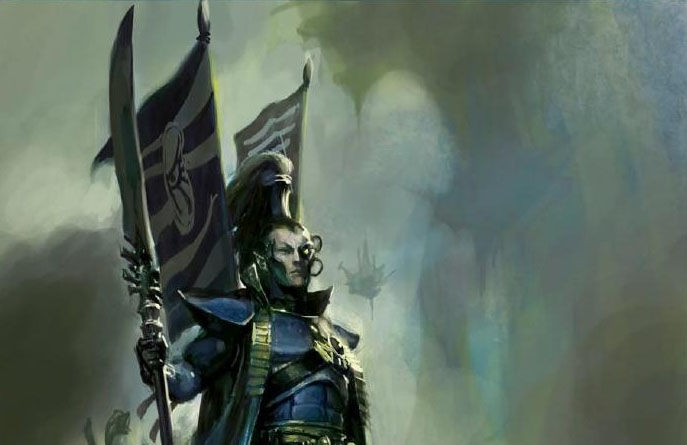
After a large number of mostly descriptive pages, we finally arrive at a genuine battle, pitting the Red Corsairs against Yriel’s Aeldari pirates.
Yriel’s spies report that, following a raid against the Craftworld Alaitoc, the Red Corsairs had returned to their stronghold in the Crimson Epoch with numerous artifacts as well as Aeldari prisoners. Determined to rescue these captives and recover the precious spirit stones held by his enemies, Yriel devises a bold plan.
His fleet is divided into two groups. The first is tasked with launching the main assault against the base once Huron’s fleet has returned and docked. The second remains hidden in ambush, ready to create a surprise at the decisive moment. The attack begins with an initial wave of swift strikes, immediately followed by the deployment of boarding vessels, allowing the corsairs to launch a lightning assault deep within the installation itself.
When Huron orders part of his fleet to pursue the Eldar vessels of the first wave, Yriel reveals his gambit and commits his reserves to reinforce the attack on the base. The operation succeeds in recovering several Aeldari prisoners as well as a number of spirit stones, the primary objective of the raid.
However, Huron quickly realizes that he has fallen victim to a diversion and immediately turns back. From this point onward, the narrative becomes more questionable. The Eldar appear to suffer particularly heavy losses, which feels surprising given their usual military doctrine. The Aeldari normally rely on mobility, surgical strikes, and rapid withdrawal before the enemy can react effectively. Seeing several of their vessels destroyed during such a carefully planned operation therefore feels somewhat strange.
The description of the fighting inside the base is equally perplexing. The account insists that only Yriel is capable of effectively confronting the Red Corsairs. This portrayal seems somewhat exaggerated. While the renegade Space Marines are certainly formidable opponents, the Aeldari corsairs are also experienced, swift, and well-equipped warriors. It is therefore difficult to imagine them being rendered helpless without the direct intervention of their leader. As a result, Yriel ends up carrying the assault almost single-handedly before ultimately being forced to order a retreat.
The withdrawal proves costly. Several corsair vessels are destroyed while Huron, true to his reputation, seizes the initiative. He teleports into the heart of one of the enemy’s principal ships, defeats its captain, and ultimately captures the vessel, which falls into Red Corsair hands.
In the end, the strategic outcome of the operation appears rather ambiguous. The Aeldari certainly succeed in rescuing prisoners and recovering spirit stones, which are objectives of paramount importance to their species. Nevertheless, the material and personnel losses seem particularly severe. When one considers the small number of survivors recovered in comparison to the several corsair vessels lost or captured, it is fair to question the true success of the operation.
Unfortunately, this battle serves as a rather disappointing conclusion. From a strategic perspective, several elements feel shaky or insufficiently justified. More importantly, the confrontation provides neither major revelations nor any significant development of the broader setting. This is all the more regrettable because the book has been enjoyable to read up to this point. Despite its highly descriptive nature, it succeeds in offering a detailed overview of the various factions operating within the Maelstrom. The final battle, however, leaves a lingering sense of incompleteness and disappointment.
The book then concludes with a series of short excerpts, notes, and supplementary texts that provide a few additional details about the region and its key players. While these passages remain interesting, they are not enough to compensate for the absence of meaningful narrative developments or major revelations that one might have expected from such a work.
What Should We Make of This Book?
While the subject matter initially seemed highly promising, the final result ultimately proves somewhat disappointing. It is certainly interesting to learn more about the Maelstrom, but one cannot help regretting the lack of information devoted to the Astral Claws and the Badab War. This omission is all the more unfortunate given Huron’s central role in the book and the fact that his story is inseparable from these pivotal events.
As for the campaign itself, the verdict is even harsher. In terms of immersion, the book displays what can only be described as a flatline. Aside from a single battle recounted over three or four pages, the remainder of the content contributes virtually nothing to the advancement of the lore. Whereas the previous volume, 500 Worlds, at least hinted at a large-scale reconquest campaign, this book hardly feels like a true campaign supplement. Instead, it functions more as an informational sourcebook, one that lacks both the depth and the level of detail found in the old Imperial Armour volumes, to which comparisons are almost inevitable.
Furthermore, previous end-of-edition campaign series generally offered a clear narrative direction and a tangible sense of progression despite encompassing multiple theatres of war. By contrast, it is now difficult to identify the overarching coherence or the real purpose behind this current series of books. The content feels particularly flat and would greatly benefit from more significant battles, higher stakes, and a genuinely epic conclusion, even an open-ended one, that would give meaning and direction to the overall narrative.
In the end, the only truly compelling aspect of the book lies in its supplementary rules, which provide players with the tools needed to create their own narrative campaigns. We intend to examine these rules closely and attempt to build our own Maelstrom campaign to determine whether these mechanics can help restore some prestige to this collection of books.
Nevertheless, we remain hopeful that future installments will reverse the trend, because at present the series unfortunately seems to be drifting into a growing sense of monotony rather than building momentum.
We hope you enjoyed this review. If you have any questions about the book, please feel free to ask them in the comments, we will be happy to answer them.
Don’t missed to support us on PATREON!
Questions, ideas, spelling error or just want to share your thoughts? Leave a comment below! And if you enjoy our work, a little support would help us keep creating more and more content.
See you soon!