Hello everyone,
A few days ago, we shared our first look at Games Workshop’s pre-painted terrain, back when it was still available for pre-order. At the time, we mainly focused on the concept, the contents of the box and what we felt was the key question: how much is the extra cost of having a ready-painted gaming table actually worth?
We have now managed to get our hands on the box and, more importantly, have had time to assemble it and examine it properly from different angles.
Having looked at the official pictures, read several early reviews and, above all, spent some time with the product ourselves, we can finally answer that question.
Our conclusion is ultimately quite close to what we expected before purchasing it: this terrain is an excellent solution for getting a gaming table ready quickly, but it is clearly not intended to replace the hobby of painting.
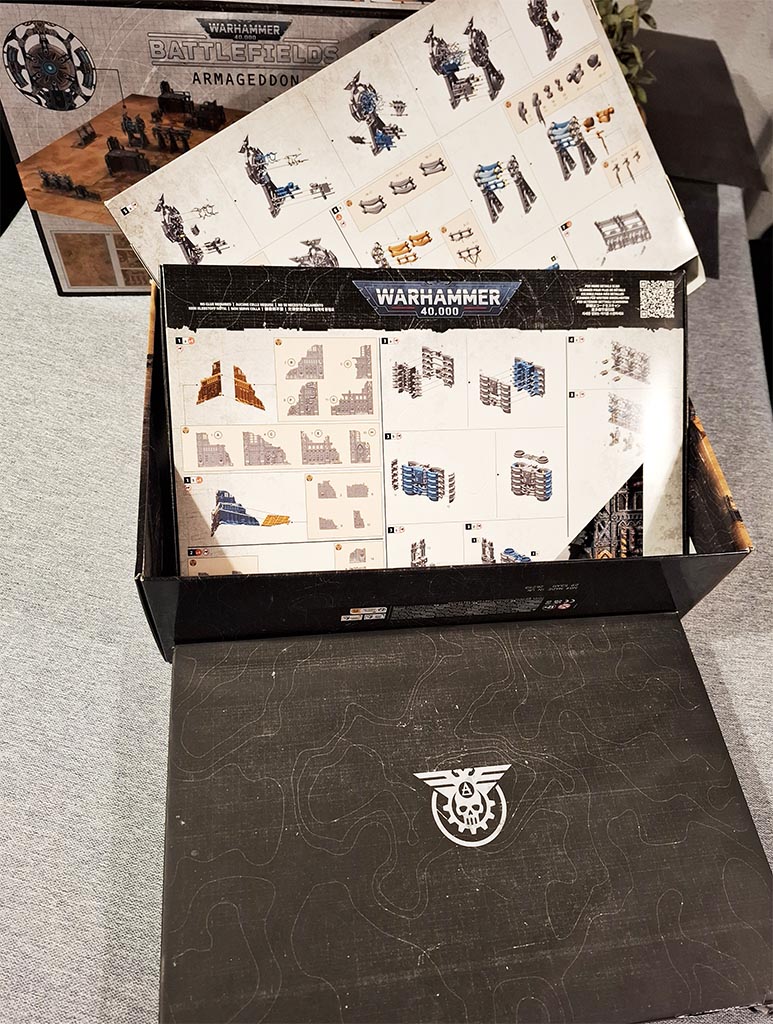
Let’s start with what immediately impressed us. Assembly is extremely straightforward.
The various components fit together very easily, and the whole set is designed to be assembled without glue. This is exactly what you would expect from a product of this kind: open the box, remove the individual pieces, put them together and your gaming table can quickly take shape.
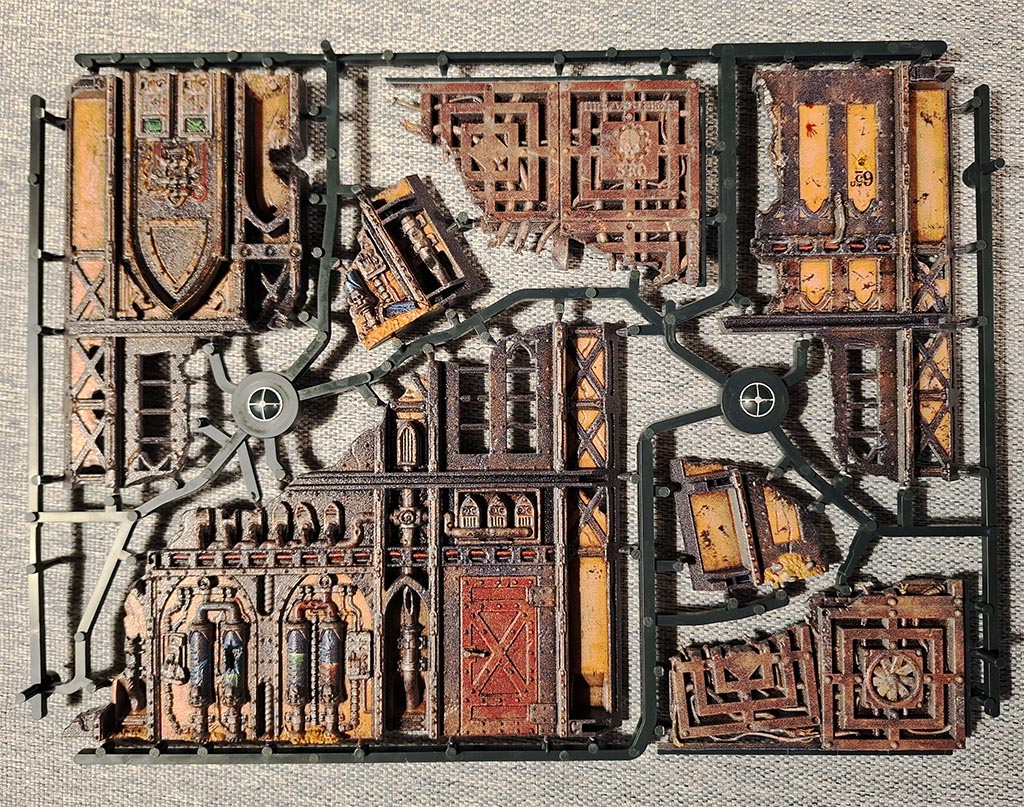
Overall, the injection points are particularly well positioned. Most of them are located in relatively discreet areas and are barely noticeable once the terrain has been assembled.
There are, however, a few exceptions.
Some injection points remain visible and become more problematic because, unlike with standard unpainted terrain, they cannot necessarily be dealt with using just a few quick brushstrokes. This is something we will come back to later.
Aside from that, assembly is a real success. Several reviews published since the release have reached a similar conclusion: the real appeal of this product lies less in the fact that it is “painted” and more in the amount of time it saves. On that front, Games Workshop has clearly understood what customers are looking for.
Once on the table, the results speak for themselves!
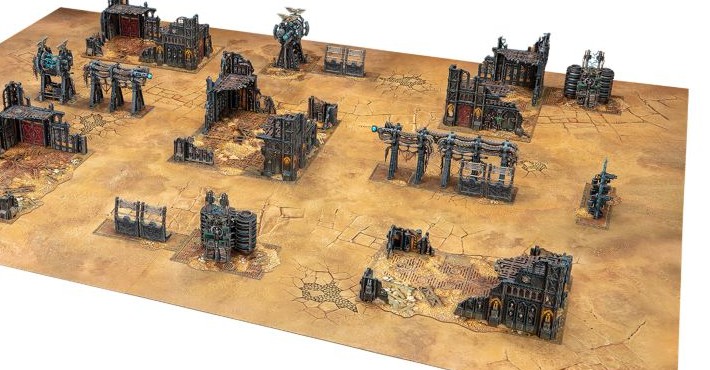
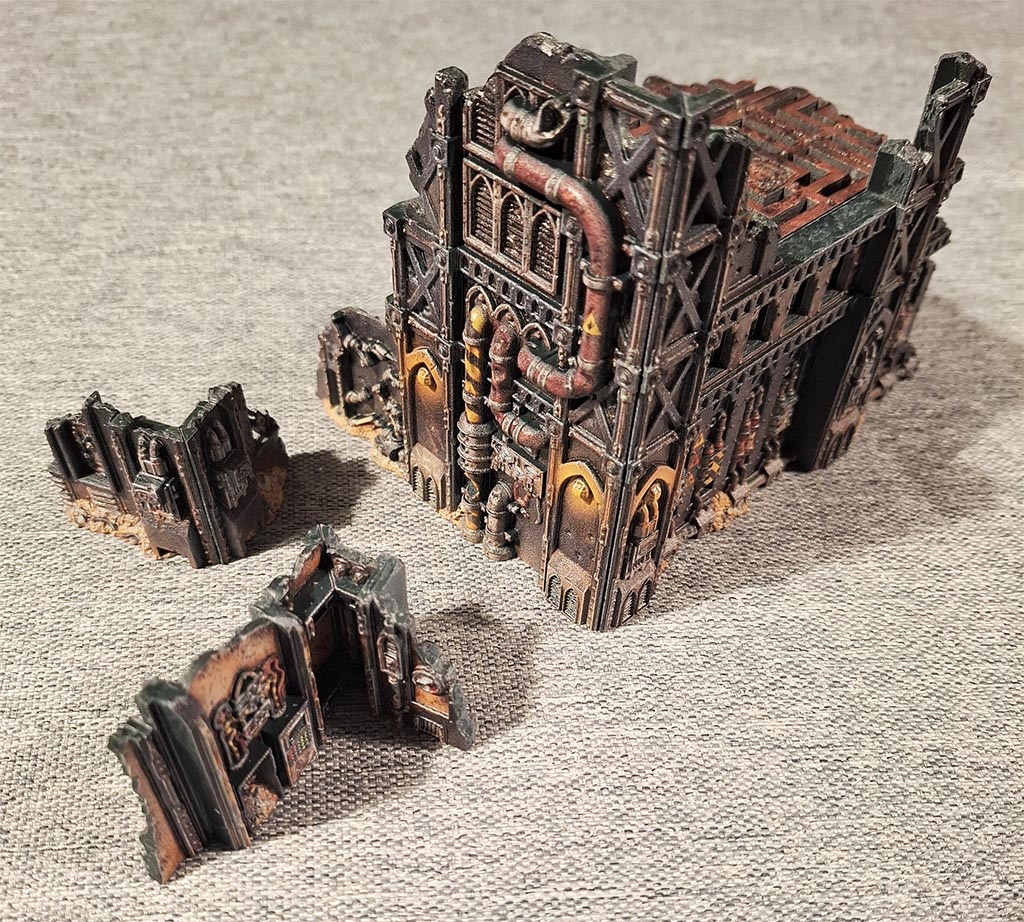
This is probably the most important aspect of our review. From normal gaming distance, the overall result is very convincing.
Once everything is set up on a table, the terrain immediately gives the battlefield a strong visual identity.
We are a long way from some of the particularly functional, but sometimes rather impersonal, tournament terrain. Here, Games Workshop has managed to create a table that is instantly recognisable as Warhammer 40,000, with greater visual variety and a genuine atmosphere. And this is precisely what makes the positioning of this box so interesting to us. It sits somewhere between purely competitive terrain and a fully developed narrative table painstakingly created by a hobbyist.
For a gaming club that needs to prepare several tables quickly, for a tournament organiser or simply for a player who wants to get gaming without spending dozens of hours painting terrain, the result is particularly effective.
But what is the paint job actually like?
This is where our opinion is probably a little more nuanced than some of the initial reviews. The level of detail is far from disappointing. On the contrary, Games Workshop has managed to retain an impressive amount of detail and colour variation for a product manufactured in this way. The different shades are generally well positioned, and the terrain certainly doesn’t look as though it has simply received a single uniform coat of paint.
The problem lies elsewhere… A speckled finish
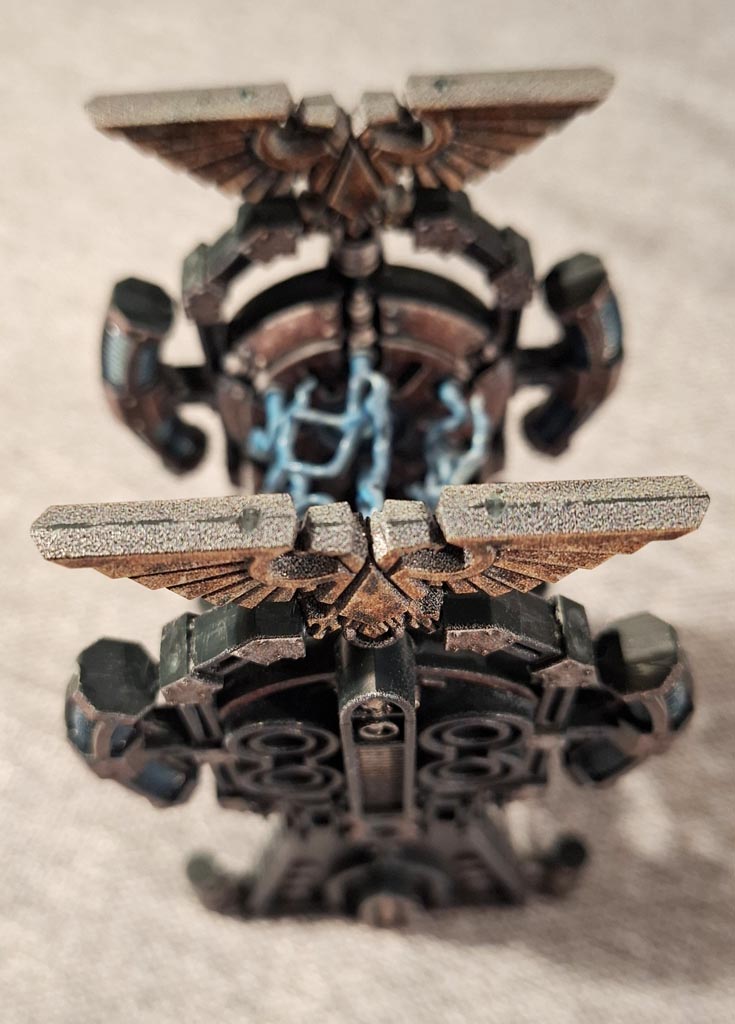
When viewed from a distance, the paint job works perfectly well. However, the closer you get, the more apparent the manufacturing process becomes. The paint has a speckled, almost grainy appearance, which creates a slightly blurred effect when looking at the details from medium distance. Several other people who have examined the terrain have also commented on this grainy or “speckled” finish. The automated painting process, particularly the UV printing mentioned in several reviews, seems to contribute directly to this distinctive appearance.
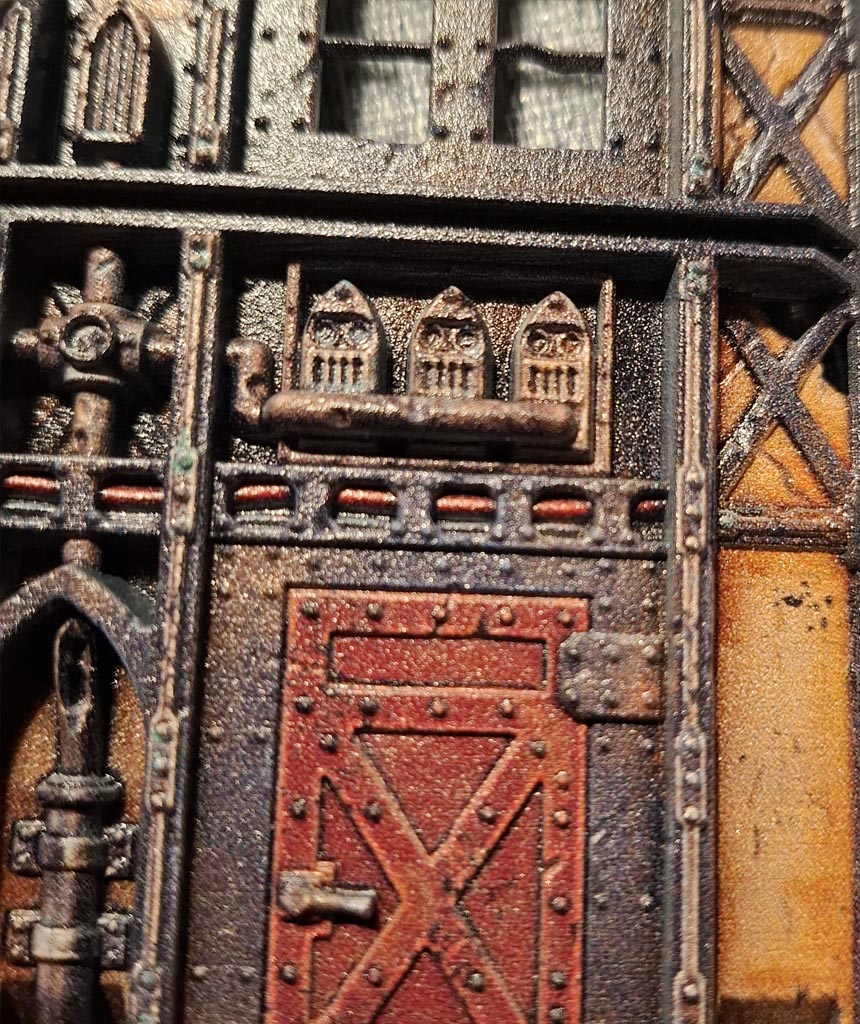
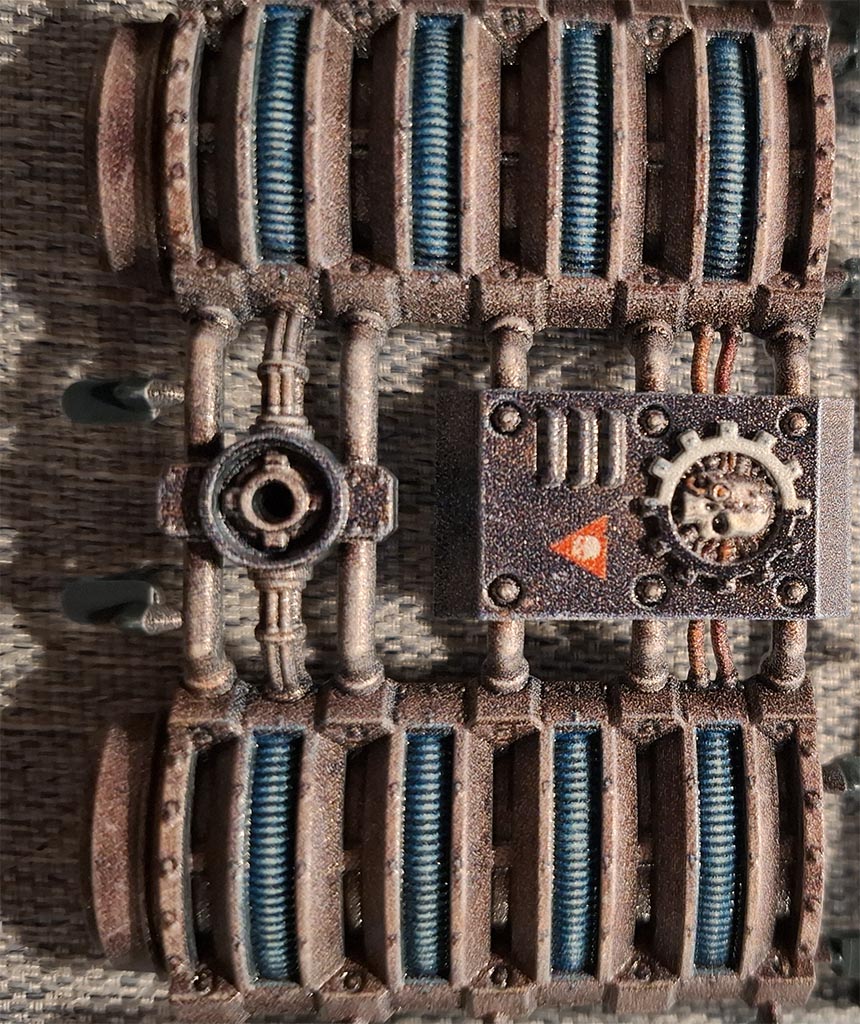
And this is precisely where our opinion differs from that of some particularly enthusiastic reviewers. We do not consider this appearance to be a major drawback for gaming. However, we do see it as a genuine limitation from a hobby perspective. At around four feet away, during a game, it is perfectly acceptable. At medium distance, the lack of precision starts to become noticeable. And when you get really close to the terrain, it becomes clear that the finish cannot compete with that of manually painted scenery, even when compared with the work of a hobbyist who has only invested a reasonable amount of time in it.
The real problem: touch-ups
This was ultimately the aspect that concerned us most before purchasing the box. Unfortunately, our fears have been confirmed. With standard terrain, carrying out a small touch-up is relatively straightforward. You identify the colour used, grab the corresponding paint pot and fix the area in question. Here, things are considerably more complicated.
The finished appearance is made up of numerous shades, subtle variations and speckled effects. Even if you can identify the main colours used, reproducing the exact shades, and especially the way they are blended together, is extremely difficult. Any touch-up is therefore likely to stand out immediately.
This is particularly problematic for anyone looking to expand their collection with unpainted terrain. Imagine wanting to purchase a few additional unpainted buildings to create a more narrative gaming table. You can obviously paint them using the same general colour scheme. But reproducing the exact finish of the pre-painted terrain is another matter entirely.
Well-positioned injection points… but not perfect
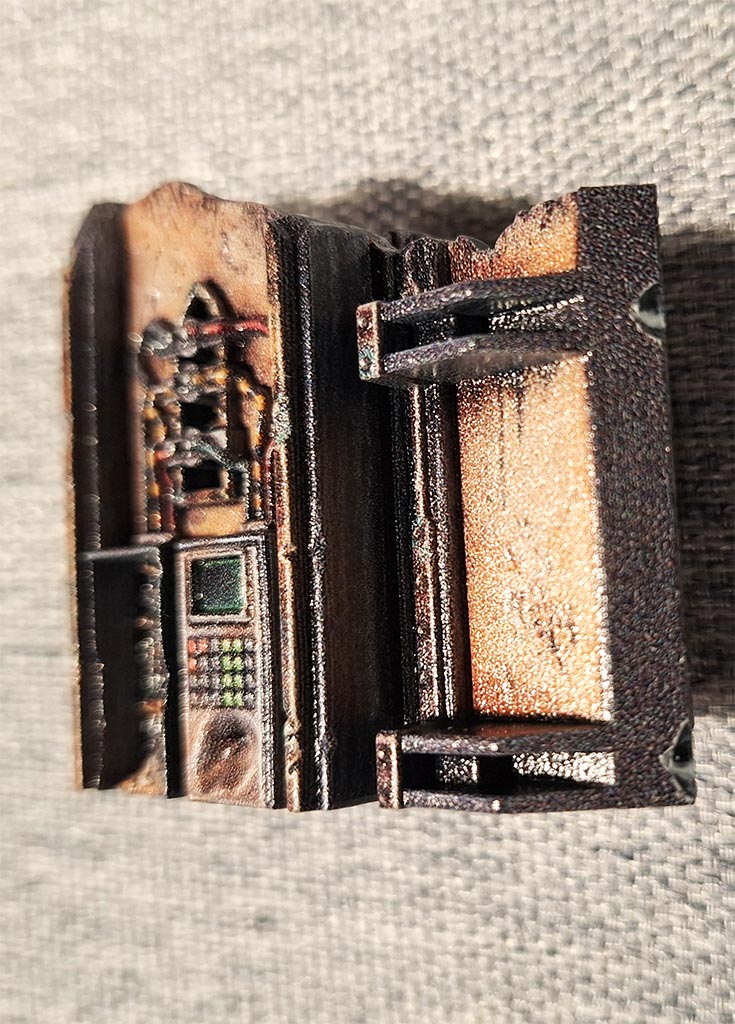
We also had a few questions about the injection points. Overall, we have to admit that Games Workshop has done a good job. Most are positioned in sufficiently discreet locations to avoid causing any problems. However, when one of them is located on a particularly visible area, things become more complicated.
With unpainted terrain, all you need to do is carefully remove the excess plastic, sand the area and repaint it. Here, cutting and sanding are still perfectly possible, but repairing the paintwork becomes much more difficult. Some other reviewers have also mentioned small marks left after removing the components from the sprues, although these generally remain fairly discreet once the buildings have been assembled and a little work has been done with a modelling knife. This is therefore not a deal-breaker, but it is something worth keeping in mind.
Another point we noticed is that the finish can look quite glossy depending on the lighting. Again, this was not something we had particularly noticed in the promotional pictures. However, under certain lighting conditions, the appearance of the paint becomes much more noticeable.
Independent reviews have also mentioned this slightly glossy finish, as well as the speckled appearance. It is not necessarily an issue during games, but it further reinforces the impression that this product has primarily been designed to look effective on the tabletop rather than satisfy the most demanding painting enthusiasts.
How does it compare with a hobbyist-painted table?
This is probably where we need to be absolutely clear. No, this terrain is not a replacement for a beautifully hand-painted gaming table.
And we do not think Games Workshop is really trying to suggest otherwise. An experienced painter will be able to achieve a more precise, cleaner and, above all, much more personalised result. They can choose their own colours, bring out certain details, add weathering, modify specific areas and, most importantly, carry out touch-ups with ease.
With this terrain, you are essentially giving up that freedom in exchange for something else: time. A considerable amount of time, in fact. That is ultimately the real product being sold here. Not simply paint, but time saved.
For gaming clubs and tournaments: it’s hard to do better
This is probably the audience for whom we would most readily recommend this box. For a gaming club that regularly needs to provide several tables, the benefits are obvious.
There is no need for several members to spend entire evenings assembling, priming and painting terrain.
There is no need to wait several weeks before having enough scenery ready to organise an event.
You assemble it, set it up and play.
For tournaments, the concept makes even more sense. The finish looks clean enough from a distance, there is a substantial amount of terrain in the box and everything immediately comes together to create a coherent gaming table.
This is precisely what makes this range so appealing: it allows players to achieve a result that many of them simply would never have the time to produce themselves.
But the price remains a significant consideration
At €320, the box obviously represents a substantial investment.
As we already mentioned in our first article, two sets of unpainted terrain cost approximately €278. On top of that, you would still need to factor in the paints, equipment and, above all, the time required to complete the work. The additional cost of the pre-painted version is therefore not unreasonable.
And this is probably one of the points we most want to emphasise after actually testing the product. We do not believe Games Workshop is selling this box at a price that is inconsistent with the service it provides. However, that does not necessarily mean we find it particularly appealing for our own personal use. These are two different things.
If you hate painting terrain or simply do not have the time to do it, €320 can ultimately be quite easy to justify (by Games Workshop standards). If, on the other hand, painting and personalising terrain are an integral part of what you enjoy about the hobby, the additional cost becomes much harder to accept.
So, what are the key takeaways from this pre-painted terrain?
The pros
- Most of the injection points are very well positioned
- Extremely quick assembly
- No glue required
- Enough terrain to quickly put together a proper gaming table
- A very convincing overall appearance when viewed from a distance
- Good variety of colours and details
- A strong Warhammer 40,000 visual identity
- An excellent solution for gaming clubs and events
- A considerable time saving
- The additional cost compared to unpainted terrain is reasonable given the work saved
The cons
- Some visible injection points are difficult to touch up
- Paint repairs are particularly tricky
- The speckled finish lacks precision at medium and close range
- The finish can appear glossy under certain lighting conditions
- Difficult to reproduce the exact shades when expanding the table with standard unpainted terrain
- Limited customisation compared to painting the terrain yourself
- The price remains high for a product that will not appeal to every hobbyist
So, should you buy Games Workshop’s pre-painted terrain?
As is often the case in this hobby, the answer largely depends on what you are looking for.
For tournament organisers and gaming clubs, we are much more enthusiastic. This is probably one of the best options currently available for quickly putting together a complete, coherent and visually appealing gaming table.
For players who have absolutely no desire to spend hours painting buildings, the verdict is also very positive. You pay more, but save a tremendous amount of time, and the result on the tabletop is perfectly respectable.
Beyond these particular audiences, however, disappointment is more likely. If you enjoy painting your terrain, are looking for a high level of detail or want to build a fully personalised narrative gaming table, the pre-painted finish will quickly show its limitations.
This is neither an inherently good nor a bad product. It is simply a product designed to meet specific needs. And that is probably the most important thing to understand about this box. Games Workshop is not selling us the best possible paint job here. It is selling us a gaming table that is ready to play. And in that respect, the gamble has paid off.
We do not particularly see ourselves repeating the experience if more pre-painted kits are released in the future. Not because we think the concept is flawed, but simply because we are not the target audience for this range.
We much prefer buying the unpainted versions and doing the work ourselves. And that is precisely why we think it is a good thing that Games Workshop continues to offer both options. Everyone can choose according to their time, their budget and, above all, the place they want the hobby itself to have in their hobby.
For our part, we mainly hope that this article, together with the many photos we have included, will help you form your own opinion.
After all, seeing this terrain in photographs taken from different distances is probably the best way to decide whether it meets your expectations.
Ultimately, we are quite happy that this range exists. But as far as we are concerned, we’ll be sticking with our paintbrushes!
Don’t missed to support us on PATREON!
Questions, ideas, spelling error or just want to share your thoughts? Leave a comment below! And if you enjoy our work, a little support would help us keep creating more and more content.
See you soon!