Hello everyone,
We recently had the opportunity to take part in a Conquest: First Blood battle report following the release of V3. Our Yoroni army, being mounted on magnetized bases, unfortunately wasn’t compatible with the format used for this report. However, thanks to our collaboration with HiigyTV, we were able to assemble and play a Weaver Courts force, which allowed us to properly experience the game under good conditions.
It was therefore time for us to share our overall impressions. In this article, we’ll go over both the strengths and the more debatable aspects of the game, while keeping a deliberately broad and accessible perspective.
To be completely transparent, we weren’t particularly excited about trying First Blood back in its V2 version. The feedback we had heard mostly described it as a “light” version of Conquest: The Last Argument of Kings, mainly intended as a stepping stone toward the mass battle format. Since we never really had the opportunity to try it at the time, we stuck with that initial impression without digging any deeper.
With the arrival of V3, however, our curiosity got the better of us. The rule overhaul and the clear intention to offer a more refined and standalone experience were more than enough to make us reconsider and see what the game truly had to offer. In the rest of this article, we’ll take a closer look at our gameplay experience, as well as our analysis of the mechanics introduced in this new version.

Broadly speaking, both games are built on fairly similar core mechanics. If you’re looking for a complete breakdown of the fundamental systems, we recommend checking out our detailed review of Conquest: The Last Argument of Kings, which already covers the key principles very well.
Here, we’ll focus on what truly sets First Blood apart from its larger counterpart. And after this battle report, our conclusion is clear: the two games now have distinct identities. We’re no longer looking at a “lighter” or introductory version, but at two different gameplay experiences, each with its own strengths and appeal.
This evolution makes First Blood far more relevant than before, whether as an entry point into the Conquest universe or as a standalone game in its own right. It’s precisely these differences, in terms of pacing, game feel, and decision-making, that we’ll now take a closer look at.
To begin with, once you’re familiar with your units’ rules, we strongly recommend building your army list using the dedicated free app. It’s very well designed: intuitive, clear, and above all extremely practical for quickly visualizing your army composition and its interactions.
In First Blood, each unit in your list is represented by a single command card. This is an important distinction to understand: unlike the regiment-based system, no matter how many models of the same type you field, you will only ever have one command card for that unit.
Where The Last Argument of Kings may require multiple cards depending on how many similar regiments you include in your list, First Blood streamlines this aspect. In practical terms, this means that all models within the same unit activate together and, importantly, are deployed all at once.
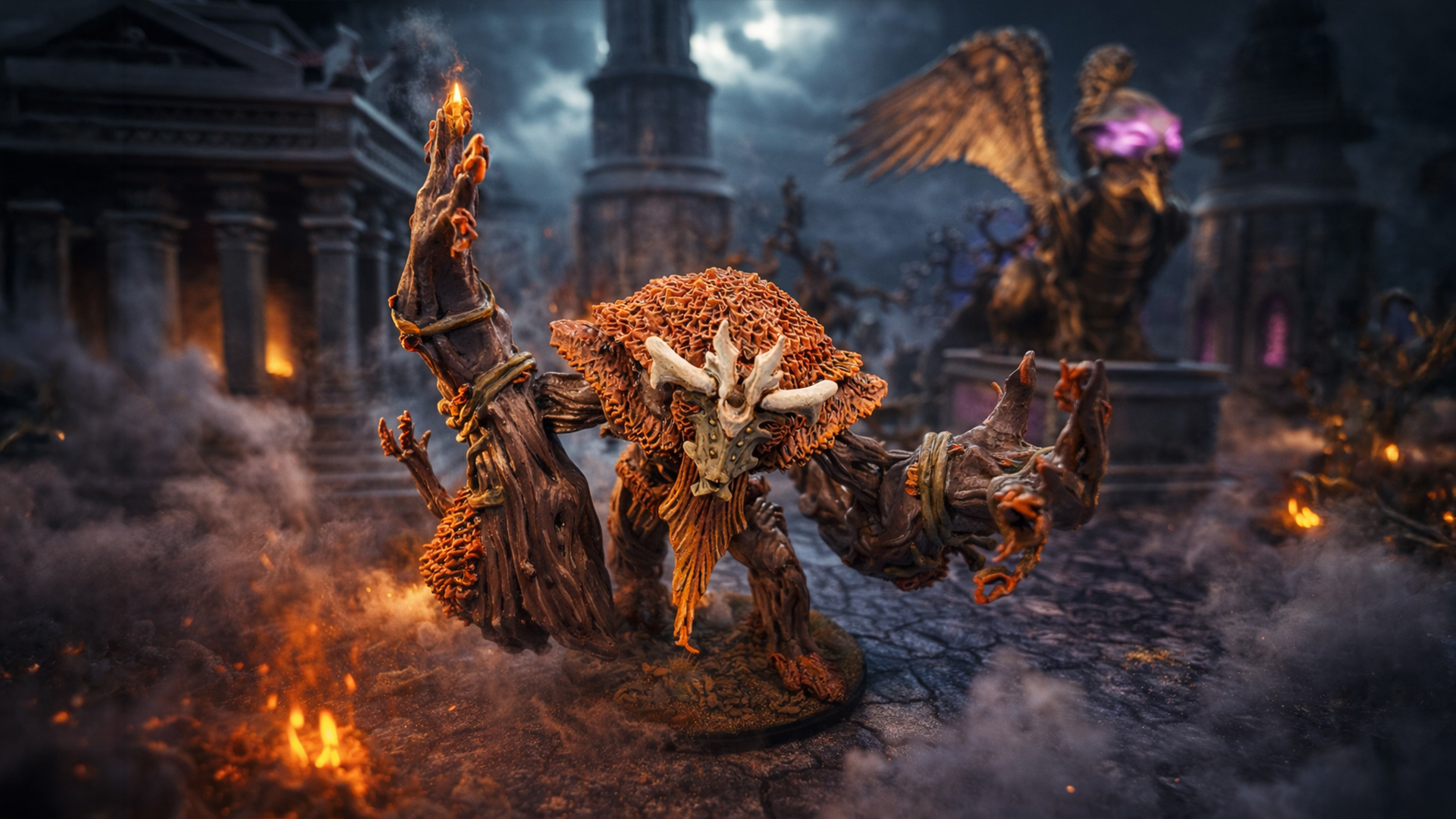
As for deployment, once the table is set up (we’ll come back to that later in the article), players alternate placing their units. The mechanic is both simple and very clever: on their turn, each player places a command card face down directly on the table, respecting a minimum distance of 9 inches from enemy cards.
This card actually represents the arrival point of the corresponding unit. Once revealed, all models linked to that card must be placed wholly within 3 inches of it. This system immediately adds a strong tactical layer right from the deployment phase.
The game truly begins as soon as the first card is revealed. From that point on, each model in a unit acts individually and can perform two actions (movement, attack, abilities, etc.). Once the activation is complete, the opponent does the same with one of their units, and so on.
This approach differs significantly from Conquest: The Last Argument of Kings. While that system relies more on regiment management and structured activations, First Blood introduces an element of bluffing and immediate pressure. Not knowing exactly which unit is hidden behind each card or precisely where your opponent will strike, creates strong early-game tension.
We particularly enjoyed this deployment system. It not only allows you to disrupt your opponent’s plans by blocking key areas, but also encourages the development of a real overarching strategy from the very first card placements. Every decision matters and can shape the course of the game.
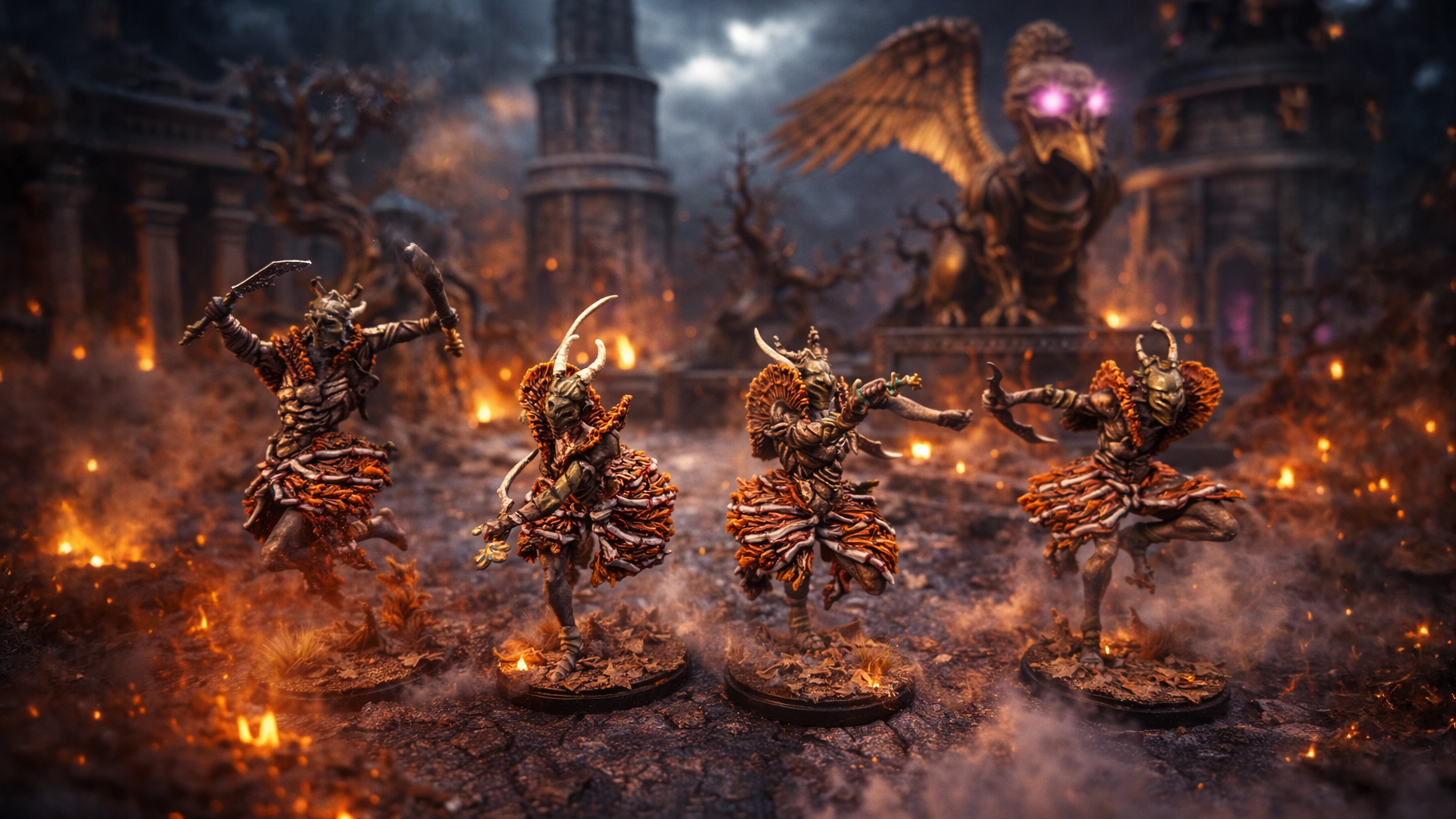
One of the game’s major strengths lies in its very accessible table formats: it can be played on 2’x2’, 3’x3’, or 4’x4’ surfaces. This not only makes it easy to adapt to the available space, but also allows for the creation of visually impressive tables, especially since terrain is not heavily restricted. As a result, hobbyists and terrain enthusiasts have a lot of freedom to create immersive battlefields.
The first major difference between First Blood and Conquest: The Last Argument of Kings is the absence of command card deck programming. Here, players alternately choose which type of unit to activate. Each activation allows all models of the selected type to perform two actions.
After determining who goes first during the Supremacy Phase, each player assigns a Command Ability to each of their characters. This ability remains active for the entire round. Players can choose from generic abilities or ones specific to each character. This phase is also when duels and magical effects are declared, starting with the player who won Supremacy. The Action Phase follows, where players take turns activating their units.
Regarding the combat system, a charge grants +1 attack die. The player then rolls a number of dice equal to their Attack characteristic. An important rule to note: rolls of 6 are always failures. The player then selects a number of dice equal to their Clash value. The opponent rolls a number of defense dice equal to their Evasion or Defense characteristic. Each defense result equal to or lower than a Clash die cancels one attack; the remaining dice count as successful hits.
When a Warrior accumulates a number of Wound markers equal to their Wounds characteristic, they must immediately take a Resolve Test. Roll a die: if the result is equal to or lower than their Resolve, they survive, ignore the excess wound, but become Broken. If the Warrior has suffered more wounds than their maximum, they suffer a -1 penalty to Resolve for each excess wound.
If the test fails, the Warrior succumbs to their injuries and is removed from the battlefield. Resolve can be reduced to 0, making the test impossible to pass. A Broken unit automatically fails future Resolve Tests and will be destroyed if it reaches its maximum number of Wounds again.
On the downside, some special rules share the same names as those in The Last Argument of Kings, but function differently. For experienced Conquest players, this can be confusing and requires some adjustment.
The scenario system is a major strength of the game. It is generated dynamically, which greatly enhances replayability. Players alternately select elements from the mission, terrain, and encounter categories, in a draft-like manner. The first player chooses one element, the second selects from the two remaining options, and the final element is determined randomly. This system creates a wide variety of setups and makes every game feel unique.
Each player then selects a tactic linked to the chosen elements, following a specific order and with no duplication allowed between players. These choices are heavily influenced by your army: committing to a specific tactic may push you to favor certain mission or terrain options, hoping to secure priority. This subtle blend of pre-game strategy and in-game adaptation is particularly well executed.
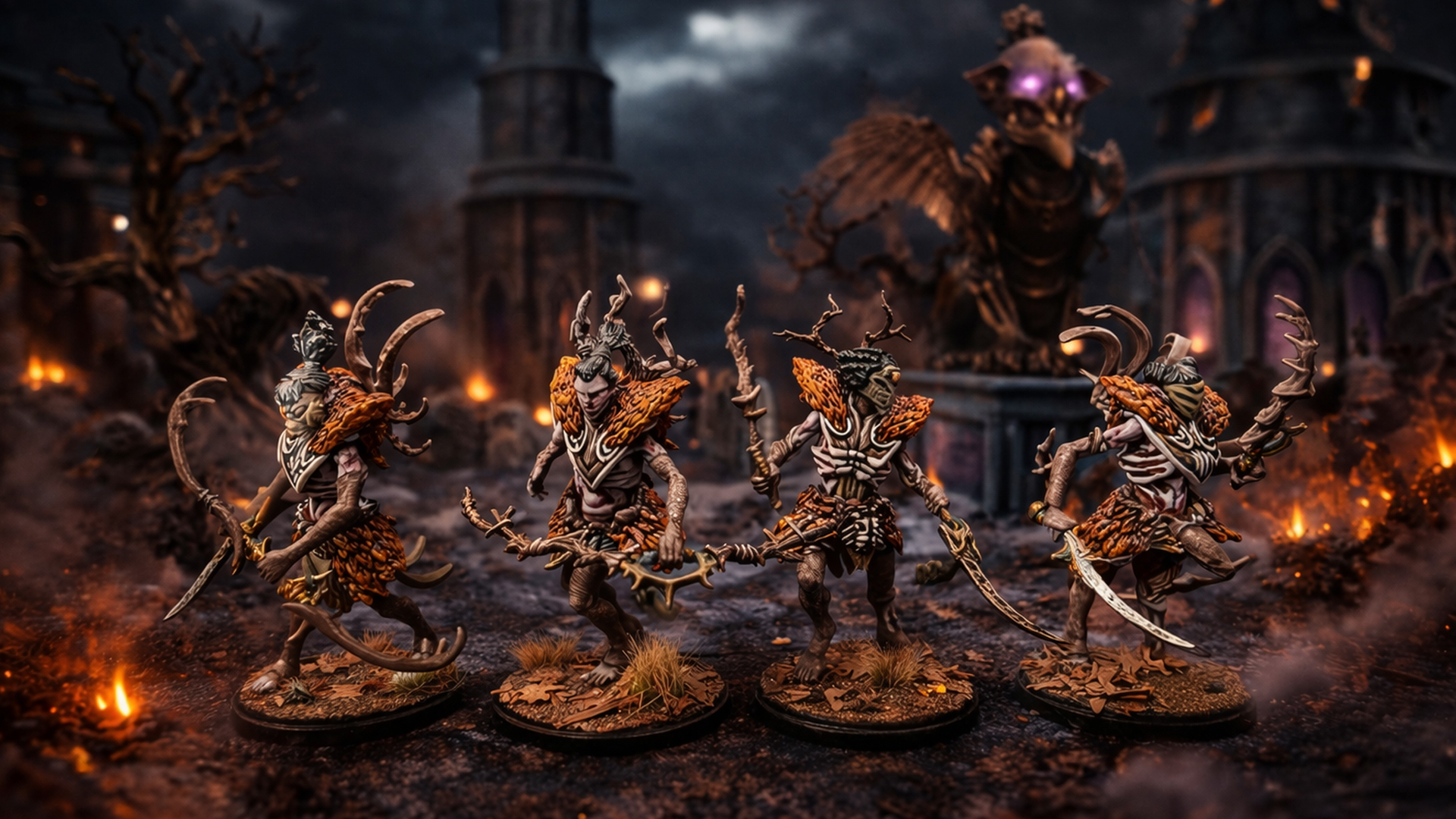
Parabellum has clearly succeeded in its goal of making First Blood a game in its own right. The warband packs are attractively priced and allow players to jump in quickly. However, expanding them can be less convenient, as it often requires purchasing full regiments.
This raises an important question: is it better to start directly with The Last Argument of Kings and then try First Blood afterward? Since the bases are compatible between the two systems, transitioning from one to the other is seamless. For our part, this experience encouraged us to explore other factions—something we might not have done in the traditional regiment-based format.
In conclusion, First Blood is an accessible game, quick to learn, and offers excellent replayability, especially compared to more rigid systems like Spearhead. The only real downside may be the introduction of monsters and 2000 points formats, which slightly dilute the identity of a game originally designed to be faster and more skirmish-focused.
Ultimately, everyone will form their own opinion, but it is clearly a worthwhile investment for miniature wargaming enthusiasts looking to explore new systems.
Don’t missed to support us on PATREON!
Questions, ideas, spelling error or just want to share your thoughts? Leave a comment below! And if you enjoy our work, a little support would help us keep creating more and more content.
See you soon!