Hello everyone,
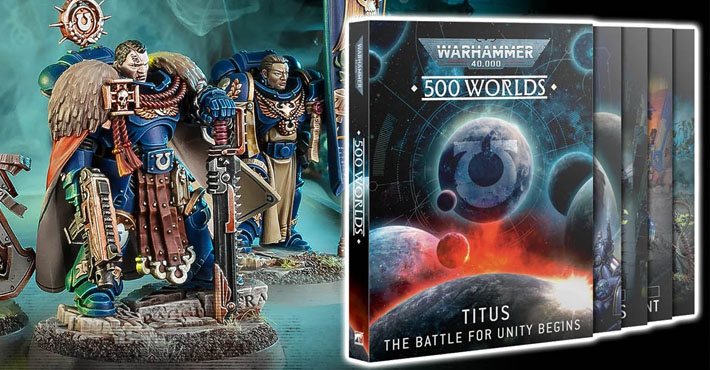
The end-of-edition campaign for the 10th edition of Warhammer 40,000 is in full swing, and for us, it’s hard not to get swept up by the narrative scale that Games Workshop is deploying to conclude this edition. Between miniature releases, lore developments, and supplemental publications, this phase marks a pivotal moment for both players and lore enthusiasts. In this context, we wanted to offer you a series of articles dedicated to the various supplements released throughout this campaign. These books are often difficult to find (limited print runs, uneven distribution), so we thought it would be relevant to provide both a detailed review and an honest opinion of their content. Today, we kick things off with the campaign history booklet “500 Worlds (Titus)”.
In an Imperium ravaged by endless war, Roboute Guilliman struggles to maintain a semblance of order across the galaxy. Weakened by the devastating Plague War, the Primarch of the Ultramarines must reassess his priorities: rather than dispersing his forces, he chooses to focus on a vital objective — the total reconquest of the realm of Ultramar, turning it into a stable bastion, a beacon of hope in a galaxy fractured by the storms of the Warp.
Whether through diplomacy or force, every planet must be reclaimed, secured, and brought back under the aegis of the Ultramarines and their numerous allies. Gradually, the Chapter and its successors rally the scattered worlds of Ultramar, bringing their military might and legendary discipline to the Primarch’s armies.
In this tense context, and in the absence of Marneus Calgar, it falls to Titus — newly promoted captain of the 2nd Company following Acheran’s disappearance — to assume a crucial responsibility. Now Master of the Watch, he supervises operations and coordinates the reconquest alongside the Chapter’s key figures. By his side are, notably, Severus Agemman for the 1st Company, Fabian for the 3rd, Uriel Ventris for the 4th, as well as Aerios for the 6th and Taelos for the 10th. Together, supported by numerous successor chapters, they orchestrate a methodical and relentless reconquest of Ultramar.
Meanwhile, the rest of the Chapter does not remain idle: already engaged on multiple fronts of the Indomitus Crusade, they will gradually join the war effort.
In this first section of the booklet, the campaign gradually begins to take shape. The main protagonists behind the 500 Worlds Crusade are introduced, along with a concise list of successor chapters engaged in the conflict alongside the Ultramarines. However, a certain frustration is inevitable: while most of these chapters already have rich, well-established histories, the booklet merely mentions them briefly. The absence of dedicated pages for each chapter is regrettable. A more thorough development would have added real value in terms of immersion and depth, much like older campaign books or the renowned Imperial Armour series published by Forge World.
In contrast, Titus receives a far more generous treatment, with a two-page history revisiting his various appearances, notably in the Space Marine video game. Now a true flagship character promoted by Games Workshop beyond the tabletop hobby, Titus establishes himself here as a modern emblem of the universe. This reminder is particularly useful for readers who may not have followed the spin-off products in which he appears.
The Ultramar Guardians also receive significant attention, with a level of detail that helps explain their role and importance. Yet this further highlights the imbalance: it is striking that these Guardians are given more in-depth coverage than all the successor chapters combined.
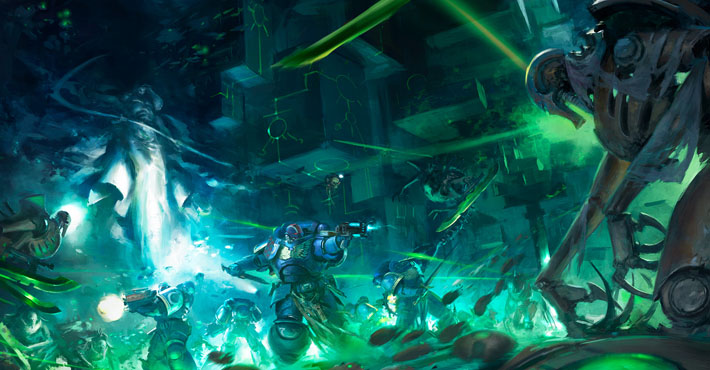
Finally, the Necron threat is extensively developed in this opening section. The booklet offers an effective recap of who the Necrons are, before delving into more specific lore elements, notably the C’tan Nightbringer and the formidable Nécrosor Amentar. The latter is an ultimate destroyer, driven by a single obsession: to gather all the shards of Nightbringer in order to reforge this god of destruction. Interestingly, Nécrosor Amentar displays a universal hatred, directed equally against the living and his own kind. This positioning makes him an especially intriguing antagonist, whose motivations transcend the usual logic of conflict and could play a central role in the campaign’s evolution. Overall, this first section lays solid foundations but leaves a sense of incompleteness in aspects that hold significant narrative potential.
The story then moves to the world of Novamagnor, a recently colonized planet of the Imperium, still vulnerable to the galaxy’s threats. Responding to a distress call identifying the Necrons as invaders, Titus immediately sets course for this new front. Upon arrival in orbit, the situation is clear: a massive Necron warship, already damaged, drifts slowly away from the planet’s surface. Without hesitation, Titus orders its destruction.
Rather than risk an uncertain bombardment, he opts for a direct, decisive approach: a deep strike into the heart of the enemy vessel. Venturing into the labyrinthine interior, Imperial forces carry out a swift operation to plant a fusion bomb at its nerve center. Resistance is minimal, as the enemy appears already weakened from previous engagements. After a brief but intense confrontation, Titus secures the area… and seizes a mysterious Necron artifact.
At this point, the Controversial Archmagos Oct intervenes, a figure as brilliant as he is contentious within the Adeptus Mechanicus. Opposed to the artifact’s immediate destruction, he presents a compelling argument: its energy instability could trigger an explosion capable of annihilating a large portion of the Ultramarines fleet in orbit. Faced with this risk, a decision must be made. Oct retrieves the artifact to study it, despite the evident dangers of such an undertaking. Titus, however, does not linger: the main threat remains on the planet’s surface. He immediately reorganizes his forces and prepares a large-scale ground intervention to liberate Novamagnor, now facing a Necron awakening of uncertain magnitude.
The campaign thus shifts scale: from a surgical strike in space to a ground war of annihilation, where every decision could seal the fate of this young Imperial world.
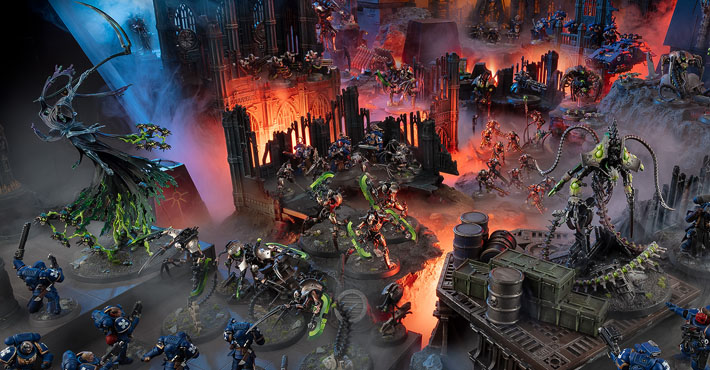
In this section, the narrative leaves little room for doubt: Oct clearly emerges as an ambiguous figure, dangerously close to heresy. Convinced that he perceives, through the C’tan, a manifestation of the Machine God, this Archmagos of the Adeptus Mechanicus appears to be pursuing goals that go far beyond the scope of the Imperial crusade. More than a mere scholar, he stands out here as a potential traitor, willing to do whatever it takes to achieve his own designs.
Facing him, Titus remains clear-headed. Wary and fully aware of the danger such an obsession represents, he is nevertheless constrained by the realities of the battlefield. Engaged in a large-scale military operation to save Novamagnor, he cannot afford to divert his forces to constantly monitor Oct. With no better alternative, he entrusts him with the study of the Necron artifact, while keeping a close watch on his actions. But the urgency lies elsewhere.
Titus’ plan is as bold as it is risky: infiltrate the Necron necropolis before its full awakening and deploy a vortex charge at its core. Such a detonation would annihilate the entire complex, neutralizing the threat before it can fully mobilize. If successful, Imperial forces would only need to hunt down and eliminate the remaining pockets of resistance scattered across the planet’s surface — a decapitation strike followed by a methodical purge.
The Ultramarines force eventually lands on Novamagnor and quickly establishes a joint strategy with the local leadership, who prove willing to join the 500 Worlds war effort. Once the front lines are stabilized, Titus leads a strike force toward the heart of the Necron citadel.
Surprisingly, the advance meets little resistance. The corridors are empty, the defenses inactive. Very quickly, several clues suggest that the necropolis is suffering from internal strife: damaged structures, failing systems… everything points to the aftermath of a simmering civil war among the Necrons. But this apparent calm is nothing more than a trap.
As soon as the Space Marines reach the chamber housing their objective, the ambush is sprung. Dozens of Necron Destroyers of all types surge forward and fall upon them with relentless violence. Caught off guard, the Imperials suffer heavy losses. The Magi tasked with arming the vortex charge are cut down one by one, irreparably compromising the mission.
The arrival of Nécrosor Amentar turns the tide of the battle. A true embodiment of destruction, he wreaks havoc among the Imperial ranks and inflicts severe losses on Titus’ force. Faced with an untenable situation — objective lost, enemies overwhelming — Titus makes a difficult but pragmatic decision: to order a retreat. There is no point in sacrificing his men in a hopeless last stand.
During the withdrawal, however, a disturbing detail emerges: the Necrons encountered in the corridors behave erratically, as if afflicted by an unknown corruption. Their movements are disordered, almost unstable, a stark contrast to their usual cold efficiency.
Titus and the survivors eventually make it back to their Thunderhawk and escape the area. The failure is bitter, but the campaign is far from over.
On the surface, the situation is just as dire. Imperial auxiliary forces struggle to contain the fury of the Destroyers, whose aggression seems amplified by a form of mechanical madness. Alongside them, or rather, against them, manifests a terrifying entity: a shard of the C’tan Nightbringer, spreading destruction in its wake.
Aware of the threat, Titus immediately redeploys his forces across the planet. His objective is no longer to strike at the heart, but to contain the enemy, buy time, and exploit the apparent disarray among the Necrons. While awaiting reinforcements, every squad becomes a bulwark, every decision a gamble. The battle for Novamagnor thus enters a new phase, more chaotic, more uncertain.
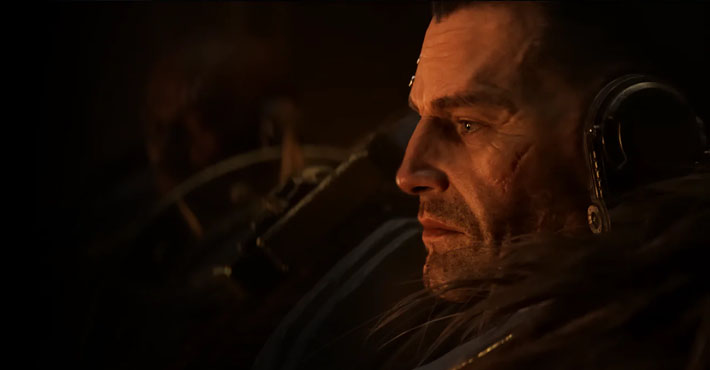
In this section, it becomes clear that the story struggles to move forward in any meaningful way. The text informs us that forces from the Sautekh and Szarekhan dynasties are clashing on Novamagnor, and that their reinforcements are becoming increasingly present, suggesting the existence of a Necron emergence point within the planet’s necropolis. While this information is relevant from a strategic standpoint, it does little to advance the main narrative.
Titus, for his part, ensures that the vortex charge is still emitting a signal and can be activated when the decisive moment arrives. This is an important technical detail, but one that the story does not fully capitalize on.
A double-page spread is dedicated to Captain Agemman and his actions in the field. Unfortunately, the narration is rather brief and clumsy. We only understand that other conflicts are taking place simultaneously, but the way this is presented, vague, disjointed, and poorly structured, ends up confusing the reader rather than informing them.
At this stage, it is difficult to determine whether these scattered elements will ultimately tie into the overall campaign, or if they are simply there to pad out the book and remind us that this is not a single planetary conflict, but a “500 Worlds campaign.” The intention is understandable, to convey the scale and multiplicity of the war, but the execution lacks coherence and clarity, at times feeling more like narrative filler than meaningful strategic or storytelling content.
The campaign continues… or rather, seems to rewind in order to retell events from the Necron perspective. The idea itself is not a bad one: exploring the other side of the conflict can add depth and context. Unfortunately, in this booklet, it quickly becomes repetitive and fails to bring anything truly new to the story.
We return to Titus’ new plan: infiltrate the catacombs through secondary routes in order to finally trigger the vortex bomb. While the Space Marines advance beneath the surface, the Necrons continue their operations above, led by Necrosor Amentar, who is determined to recover the artifact held by Oct, one that contains a shard of the C’tan Nightbringer.
After the expected battles, heroic moments, and inevitable losses, the bomb is finally activated and destroys its objective. At the same time, Ammentar eliminates the Skitarii and Oct, retrieves the artifact, and disappears. Titus, satisfied with the victory, begins to see a future for Novamagnor.
The book remains interspersed with segments related to the wider 500 Worlds campaign, but these add little to nothing. Often vague and lacking clarity, they fail to enrich the narrative and instead feel like reminders of the supposed galactic scale of the conflict.
The only truly memorable moment is a vox transmission from Lion El’Jonson, announcing his intention to speak with his brother, finally a development that could meaningfully connect to other narrative arcs.
In the end, the booklet suffers from several inconsistencies and questionable narrative choices:
- Why were Techmarines not brought in to activate the vortex bomb during the first assault?
- The Necrons consider the bomb inferior, yet it destroys an entire complex — something that should logically make it a credible threat in their eyes.
- Oct, presented as a traitor, ultimately plays a minor role and mainly serves to avoid a second direct confrontation between Titus and Ammentar.
All these digressions and pacing issues unnecessarily stretch the story and lead to a predictable conclusion. The overall impression is one of wasted potential: the narrative would have benefited from focusing on smaller, more impactful operations, with one or two major threats affecting the 500 Worlds.
There were many opportunities to explore already established storylines — the Tau expansion blocking Imperial borders, the continued presence of the Tyranids, or the vengeance of Mortarion following the Plague War. All of these offered rich narrative potential yet remain largely untouched in this booklet.
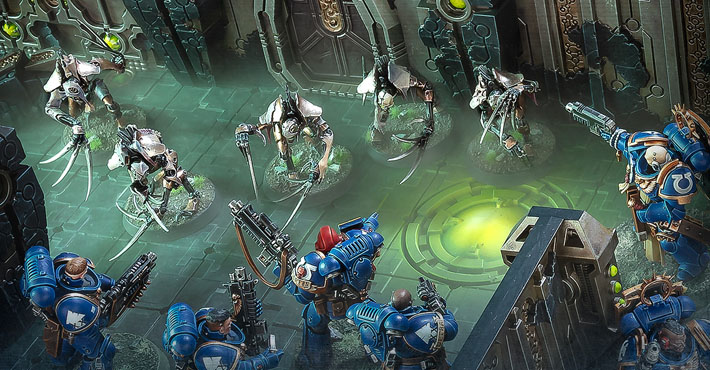
We are big fans of campaign books, and we had high expectations for this one. Unfortunately, several aspects left us somewhat disappointed, starting with the softcover format, which does not reflect the usual level of care put into Games Workshop publications. But that is far from the only issue.
Above all, we were expecting a book showcasing the various strategies, plans, and maps that Titus and Roboute Guilliman would employ in the conquest of the 500 Worlds. Instead, the result is very different. The book focuses almost entirely on the description of a single battle, reinforcing a sense of repetition and making the outcome predictable for any reader.
It would have been far more engaging to build a true galactic campaign, featuring multiple well-known characters and several factions, as seen in previous campaign books from the Warhammer 40,000 universe.
The conclusion, in addition to being open-ended, feels rather flat: Titus continues his campaign, while Ammentar keeps moving from world to world, gathering shards of the Nightbringer. Most disappointing is the fact that much of the narrative revolves around Necrosor, yet his conflict largely consists of fighting other Necrons. His main objective — collecting the shards of the Nightbringer — ultimately narrows the scope of the story, which barely impacts the wider galaxy.
We can only hope that future campaign books will be more structured, more varied, and truly live up to the concept of the 500 Worlds, delivering immersive and strategically rich narratives for all Warhammer 40,000 enthusiasts.
Overall, the book is not poorly written: the characters are well established, the lore is respected, and certain scenes offer a satisfying level of immersion. However, it lacks that old flavor — that intangible quality that once made campaign narratives feel truly epic.
One might wonder whether this feeling comes from the absence of a true global campaign, complete with a dedicated website, organized events, and interactive tracking — or simply from the loss of the narrative and “fun” elements in gameplay, those moments that made us feel truly involved in the story. The result is a solid but ultimately unsatisfying narrative, leaving a lingering impression of something missing, as if the epic scale has been diminished despite the full potential of the 11th edition.
We hope you enjoyed this review. If you have any questions about the book, feel free to ask them in the comments, we’ll be happy to answer.
Don’t missed to support us on PATREON!
Questions, ideas, spelling error or just want to share your thoughts? Leave a comment below! And if you enjoy our work, a little support would help us keep creating more and more content.
See you soon!