Hello everyone,
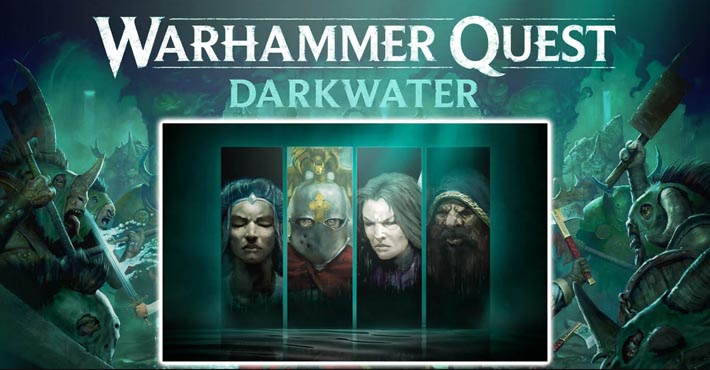
We were thrilled to hear about the release of a new game in the Warhammer Quest series. However, one question quickly arose: does the game live up to its predecessors? In this article, we will share our perspective to give you an honest and objective opinion. More detailed articles will follow soon to present the campaign, the miniatures, and the various game elements. We plan to create these pieces with painted miniatures and carefully staged setups. This article’s main goal is therefore to help you make an informed decision: should you buy this new Warhammer Quest or not?
Many of us had numerous questions at its release. The game arrived somewhat hastily, just before the Christmas holidays, and very few articles actually addressed the new gameplay mechanics. The first thing that, in our opinion, raised concerns was the disappearance of the traditional dungeon tiles in favor of an exploration book. We were among the first skeptics. Yet, after several sessions, it’s clear that this choice works quite well. The book is enjoyable to use and allows for a quick setup. Nevertheless, we did notice some printing defects on certain copies, and the quality is not always flawless, even on a brand-new product.
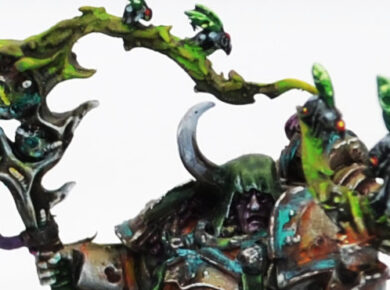
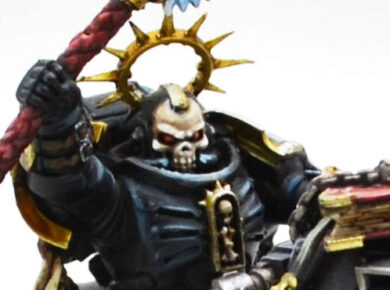
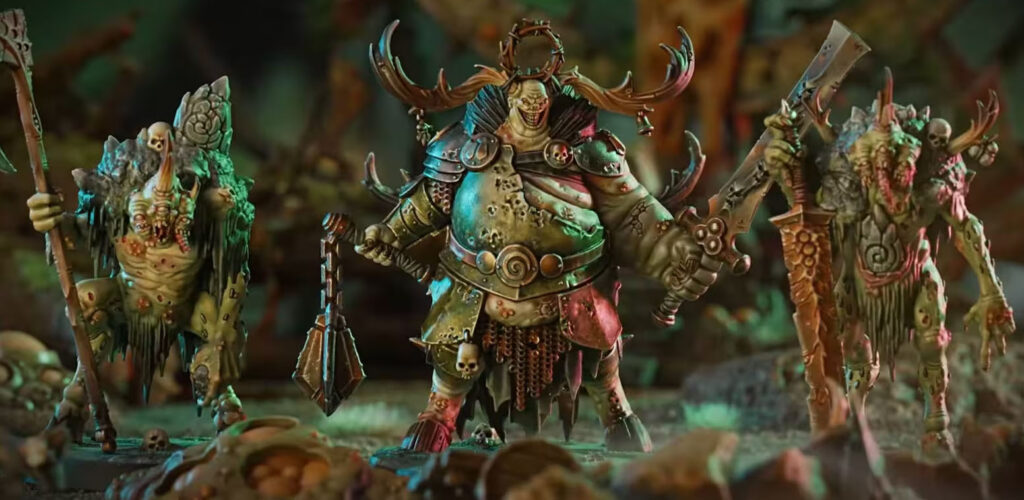
As for the miniatures, there is generally nothing to criticize: Games Workshop confirms its market-leading status. The sculpts are detailed, dynamic, and enjoyable to paint. However, the final boss left us slightly underwhelmed. Some details, especially the fur on the shoulders, lack finesse, and from a purely personal point of view, its Soulblade did not particularly impress us.
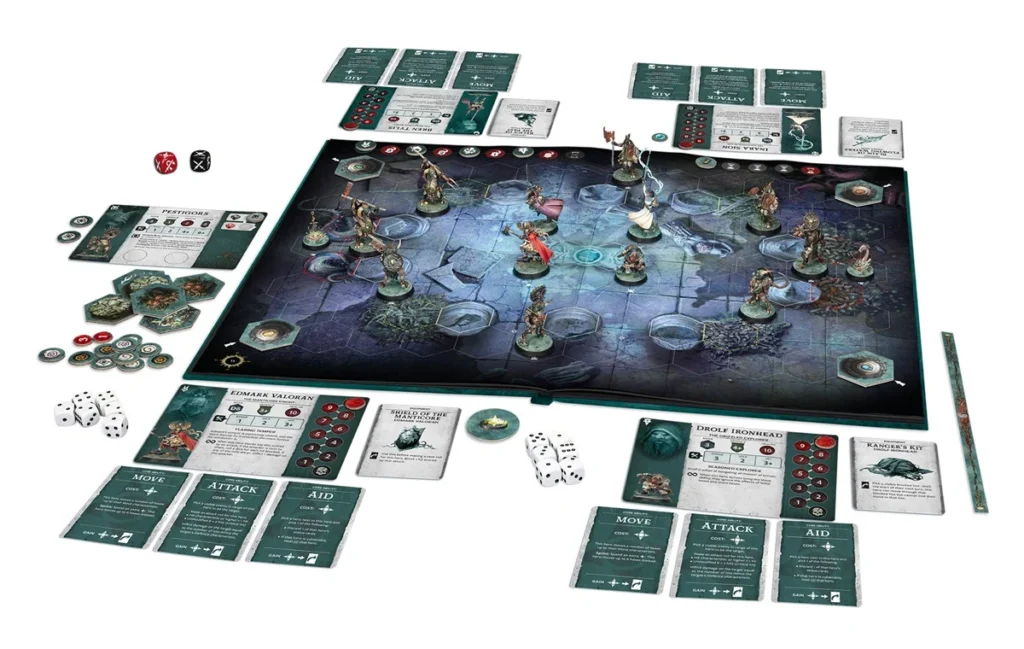
Darkwater offers a clearly simplified version of the previous Warhammer Quest games, with a more accessible action system that is quicker to grasp. Each hero has three actions per activation, represented by cards, as well as alternative actions triggered in case of critical danger.
Movement is often random but can be stabilized by spending two actions. However, it’s clear that sacrificing a second action is rarely an option. Indeed, the turn limit, sometimes very restrictive depending on the mission, encourages players to optimize each activation rather than securing their movements.
Combat relies on simple rolls: hit on 3+, critical on 6+, with damage modified by the enemy’s armor. While this system is easy to understand, offensive effectiveness can be unpredictable, with significant variation from one attack to another.
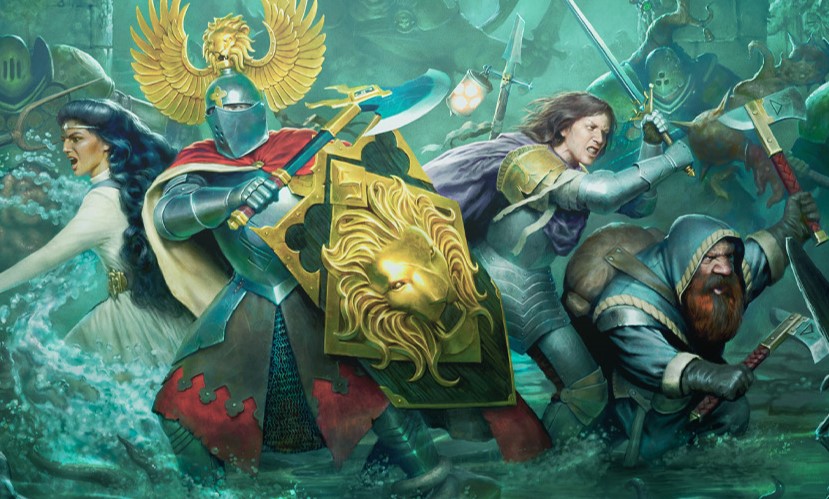
For the first campaign, only four heroes are playable: Edmark Valoran, Bren Tylis, Drolf Ironhead, and Inara Sion. This is a regrettable limitation, as in some missions, the strengths or abilities of other heroes would clearly have been beneficial, providing greater tactical variety.
The dice system has also been simplified: everything now uses D6, while specific dice control enemy behavior. These introduce often striking, sometimes dangerous, special effects, adding real tension to encounters. This simplification makes the game smoother while maintaining diversity in combat situations. However, the mechanic can become a bit cumbersome when many enemies are on the board, as resolving actions then requires a large number of dice rolls.
A major positive: the game is quick to set up, and the rules are light (perhaps even too light) and easy to grasp, making it highly accessible, even for less experienced players.
On the downside, some important rules lack precision. This is particularly true for enemy movement in random directions, which can leave players confused and force them to improvise or interpret certain situations. This lack of clarity can break immersion and disrupt the game flow during certain sessions.
Setup
Players choose one to four heroes, along with a leader, and then build the Act I deck. This deck consists of a boss fight and 14 cards randomly drawn from three types:
- Encounters: combat missions
- Events: situations without direct combat
- Rests: allowing players to recover health at the cost of rewards
At each stage of the campaign, two cards are drawn, and players choose their next mission based on the flavor text. This system creates a constant balance between caution and risk-taking. The more risks players take, the more they can earn Reward cards, which enhance the heroes’ abilities. These rewards, of varying rarity, provide different bonuses such as extra movement, additional attacks, or conditional actions.
The campaign is generally more forgiving than other Warhammer Quest games, as a mission can be attempted multiple times before causing a permanent failure. This helps limit frustration due to randomness. However, some missions remain very challenging, and repeating them can quickly become frustrating. For certain missions, we even questioned whether sufficient playtesting and balancing had been done. Difficulty can be inconsistent: one mission may feel too easy, while the next seems almost impossible. With some thought, these imbalances could have been easily corrected. Let’s be clear: if you fail a mission a second time, just treat it as if you had succeeded. Repeated failure on an almost impossible mission can quickly make you want to give up (experience speaking). On the other hand, moving on to a completely different mission revives the adventure and enthusiasm (also based on experience).
Completing seven missions and defeating a boss ends an act. This dual mission selection adds high replayability, thanks to the variety of bosses and encounters. Each campaign is therefore unique.
Each act follows a similar structure, with new missions each time, further increasing replayability. The difficulty of scenarios and the power of magical items gradually increases. From a narrative perspective, an act can be compared to a Vermintide campaign (the video game): each mission tells a small, self-contained story, independent from the next, up to the final boss. Actions and consequences do not carry over to subsequent missions, unlike previous Warhammer Quest games.
This system allows for great diversity of situations and high replay value. Let’s be clear: this is not the Warhammer Quest we once knew. After several sessions, it clearly appears as a more family-oriented game, perfect for a lunch break or an evening with friends. Its simple rules and average scenario length (around 30 minutes) make it highly accessible, offering many quick and approachable missions for everyone.
Strengths
- Quick to set up and easy to learn, with missions lasting around 30 minutes, ideal for short play sessions.
- Beautiful miniatures, true to Games Workshop’s craftsmanship and easy to assemble.
- Excellent replayability, thanks to the variety of situations and mission choices.
- Diverse missions that genuinely make you want to play again.
- Well-designed exploration book, visually appealing and enhancing gameplay comfort and immersion.
Weaknesses
- Storage system is too light, or even non-existent, making it inconvenient after use.
- Some missions and rules feel rushed, with unclear points and balancing issues.
- Narrative is somewhat light, occasionally lacking depth.
- Book can be damaged upon opening, and for fans of modular tiles, the disappearance of a buildable dungeon may disappoint.
- High price: while the miniatures are excellent, the cost is hard to justify considering the relatively light supplementary content.
Warhammer Quest: Darkwater is therefore a family-friendly game that can provide very enjoyable moments. The solo mode, however, has little interest: this is clearly a game designed for group play, without stress, apart from a few unnecessarily complex missions and some vague rules.
Ideally, we would have preferred a version with fewer miniatures, or at least a progressive bestiary that could be expanded throughout the campaign, providing richer supplementary content. By supplementary content, we mean: a modular dungeon rather than just a book, a proper storage system with compartments, solid rules, and above all better playtested missions.
Paying 175 euros is clearly disappointing. Games Workshop seems to be selling the miniatures more than the game itself, especially since they were released separately shortly afterward. It’s a shame, because the game has real potential, particularly for players who want to customize or enhance it. Still, at this price point, we would have liked a game truly complete right out of the box, with substantial content comparable to other dungeon crawlers that are significantly cheaper.
It remains to be seen how Darkwater will be supported over time. Despite its flaws, it’s a game we enjoyed, but it is not suited for those seeking a deep, challenging, and narratively rich dungeon crawler.
On the other hand, it’s an excellent introduction to the world of miniatures, perfect for playing with your children or enjoying relaxed sessions with friends. And like any self-respecting wargamer, you will likely adapt or simplify certain unclear rules to focus on what really matters: having fun around the table, with family or friends.
We’ll be back once the miniatures are painted, to share a more in-depth look at our Darkwater experience.
Don’t missed to support us on PATREON!
Questions, ideas, spelling error or just want to share your thoughts? Leave a comment below! And if you enjoy our work, a little support would help us keep creating more and more content.
See you soon!